

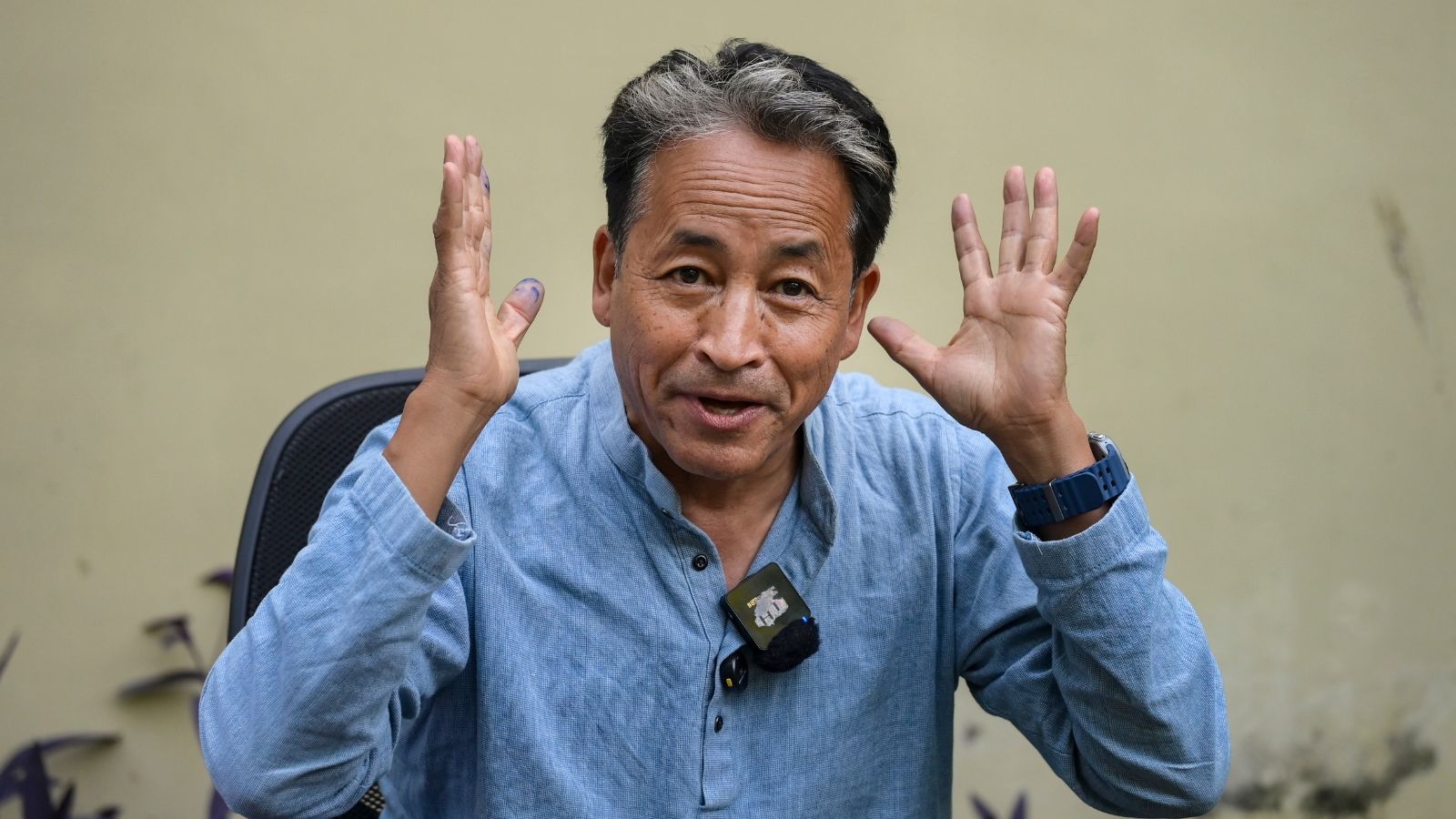


Leh: Education reformist and climate activist Sonam Wangchuk has cited administrative delays in executing the land lease for the Himalayan Institute of Alternatives, Ladakh (HIAL), claiming he made five written appeals, 15 visits, and 30 phone calls to secure the deed.
Wangchuk, the institute's founding director, shared an official communication dated 19 February 2021 from the Ladakh administration to support his claim that the delay was not his responsibility.
His statement comes after the administration defended its decision to cancel HIAL's land allotment, citing what it described as the activist's “disregard for the law”. It maintained that the allotment had lapsed because mandatory dues were not paid and the lease deed was not executed within the stipulated period.
In an affidavit filed recently in the High Court of Jammu and Kashmir and Ladakh, the administration said the 40-year lease allotment covering 1,076 kanals and 1 marla of land at Phyang Thang had “lapsed by operation of law” on 5 May 2019. It cited HIAL's failure to execute the lease deed or deposit the required land premiums within one year of the original allotment.
The 136-page affidavit was filed by Leh Deputy Commissioner and Ladakh Autonomous Hill Development Council (LAHDC) chief executive officer Romil Singh Donk in response to HIAL's writ petition challenging the cancellation order issued on 21 August 2025.
Also Read:
Wangchuk points to administration's 2021 letter
In a Facebook post accompanying the letter issued by the Office of the Deputy Commissioner and LAHDC chief executive officer in Leh, Wangchuk accused the authorities of targeting him and the institute whenever he raised concerns about Ladakh.
“Whenever I raise my voice about injustices in Ladakh, the government media machinery gets activated to target me and our institute HIAL's land lease. Please take the message, don't kill the messenger,” he said.
The February 2021 communication stated that execution of the lease deed was under process while the administration awaited the finalisation of a new lease policy following Ladakh's formation as a Union Territory and the COVID-19 pandemic.
“…in the wake of the formation of the new UT and the pandemic, the execution of the lease deed is under process as we are awaiting the New Lease Policy to be finalised. This delay is across the board for all institutions, including several government institutions; however, you may continue the construction activities of your institution on the allotted land,” the letter stated.
Wangchuk said the document demonstrated delays on the administration's part.
“A quick look at this letter shows their own delays, if not incompetence. In all, five written appeals, 15 visits, and 30 calls were made appealing for timely execution of the land lease,” he said.
Also Read:
Administration says allotment lapsed in 2019
In its affidavit, the administration described HIAL's petition as “misconceived, devoid of merit, and barred by delay and laches”.
It maintained that the original allotment order, issued on 5 May 2018, was conditional and explicitly stated that the lease would be deemed cancelled if the allottee failed to execute the deed within one year.
Gitanjali Angmo alleges false claims
Wangchuk's wife, Gitanjali Angmo, who is also a HIAL co-founder, rejected the administration's claims and alleged that the affidavit contained falsehoods. She compared it with what she described as false allegations made against Wangchuk in connection with his detention under the National Security Act (NSA).
“In the court, they (administration) said they wanted to change the facts and refile the affidavit. Maybe they realised they would be caught again. Everything is a lie,” Angmo said. “They are so incapable that they do not even have a lease policy in place.”
She said Wangchuk's contribution to Ladakh had been recognised locally since 2007. Criticising the frequency of administrative changes, she said Ladakh had seen four lieutenant governors and six deputy commissioners in Leh over the previous five years.
“We do not depend on the administration or the so-called lieutenant governors who come and go every six months. In the last five years, we have had four L-Gs and six deputy commissioners (in Leh). They have no stake in the place apart from exploiting it,” she said.
Angmo alleged that the administration was attempting to clear the plot by spreading false claims and creating a misleading narrative.
Wangchuk links dispute to wider tensions in Ladakh
Wangchuk was detained under the NSA following violence in Leh during protests in September 2025 demanding statehood and the extension of the Constitution's Sixth Schedule to Ladakh. He was released in March 2026 after the Union government revoked the detention order.
Wangchuk also rejected allegations concerning the circulation of provocative video compact discs (VCDs) by his organisation, the Students' Educational and Cultural Movement of Ladakh (SECMOL), and the unauthorised occupation of 200 kanals of land under the guise of educational programmes.
He described these allegations as part of an effort to damage his reputation because he had challenged the government over promises made to the people of Ladakh. He said the authorities were reopening matters that had already been settled.
Also Read:
“In 2007, there was similar high-handedness. They tried everything to put me in jail, but they could not. There are several letters from the erstwhile deputy commissioner alleging I had disturbed peace. As in this case, there was a national and global outcry in 2007 as well. Finally, President A P J Abdul Kalam intervened, and the deputy commissioner was removed prematurely,” he said.
Wangchuk argued that the earlier episode demonstrated what he described as the misuse of power. He alleged that the authorities were now raising the lease dispute and other issues to derail the institute's land allotment because of his political positions and criticism of the government.
“We would rather die than submit to such high-handedness. We did not submit to it during the previous regime, and we won't submit to it under the current regime,” he said.
Referring to earlier cases mentioned in the affidavit, Wangchuk said he had been acquitted by the court and questioned why those matters were being raised again.
“Cases were filed against me back then; the affidavit mentions all those matters. The court acquitted me. How can they bring them up again when the court has already given its verdict?” he said.