

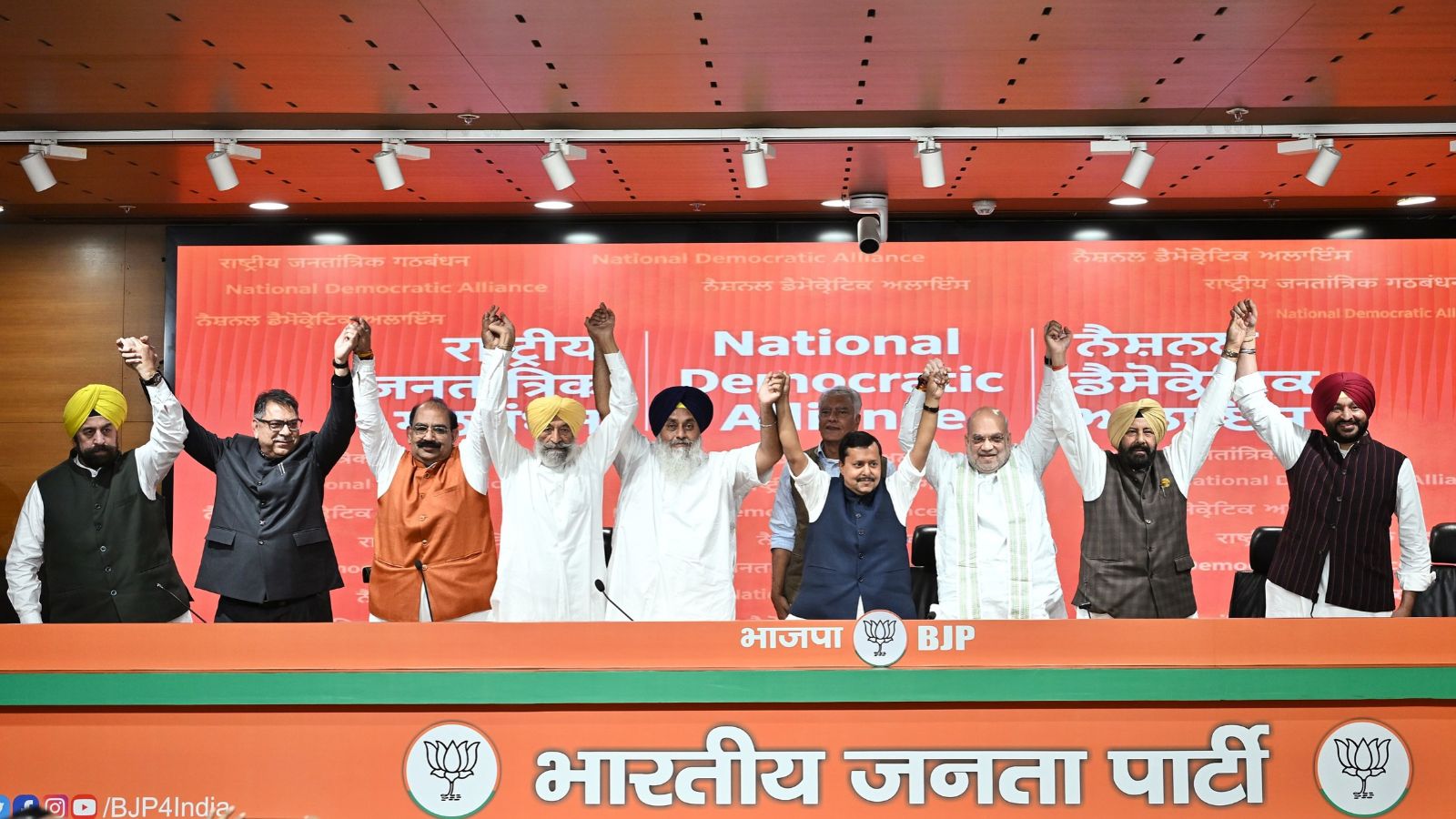


The Akali Dal will be the senior partner, the alliance will contest all 117 Assembly seats, and Punjab will have a chief minister from the regional party if the NDA returns to power. Union Home Minister Amit Shah made the political equation clear on Tuesday as the Bharatiya Janata Party (BJP) and the Shiromani Akali Dal (SAD) formally reunited after six years of separation.
Announcing the alliance alongside BJP national president Nitin Nabin and SAD president Sukhbir Singh Badal in New Delhi, Shah also set December 31, 2029, as the target for making Punjab drug-free.
Shah revealed that the two parties had spent the past three months preparing a roadmap for Punjab and that Prime Minister Narendra Modi had spoken to both Badal and Nabin following the development.
Badal, meanwhile, described the reunion as an emotional alliance rooted in Hindu-Sikh unity and expressed confidence in winning more than 100 seats in the 2027 Assembly elections.
Behind the symbolism and political messaging, however, lies a pragmatic electoral calculation. Six years of contesting separately have exposed the limitations of both parties in a state where the political landscape has changed dramatically.
The electoral compulsions behind the reunion
The Akali Dal walked out of the National Democratic Alliance (NDA) in September 2020 over the Centre’s controversial farm laws, ending a 24-year partnership. Harsimrat Kaur Badal resigned from the Union Cabinet as the party faced mounting pressure from its traditional agrarian support base.
Although the laws were subsequently repealed in 2021, the political consequences of the separation were evident in the 2022 Assembly elections.
The SAD secured just three seats and the BJP won two, while the Aam Aadmi Party (AAP) swept Punjab with 92 seats. Congress was reduced to 18.
The 2024 Lok Sabha elections revealed an equally interesting political shift. The BJP secured approximately 18.6 per cent of the vote in Punjab, ahead of the Akali Dal’s 13.4 per cent. Yet the BJP failed to win a single constituency, while the SAD retained Bathinda.
Their combined vote share of nearly 32 per cent was higher than that of either Congress or AAP individually.
While vote shares cannot simply be added to predict electoral outcomes, the numbers explain why reviving the alliance has become politically attractive to both parties.
An old alliance with a new power equation
Perhaps the most significant aspect of Tuesday’s announcement was Shah’s willingness to concede the senior partner position to the Akali Dal.
Under their previous arrangement, the SAD contested 94 Assembly seats, leaving 23 for the BJP. But six years of independent political expansion have altered the BJP’s bargaining position.
The party’s increased vote share in the 2024 parliamentary elections gives it grounds to seek a larger electoral footprint. The Akali Dal, however, needs to retain its regional identity and leadership position as it attempts to rebuild its political relevance.
Shah’s assurance resolves the immediate question of political hierarchy, but the distribution of constituencies remains unsettled.
The eventual seat-sharing formula will offer the clearest indication of how much the balance of power within the alliance has changed.
From farm laws to governance
The choice of Guru Nanak Jayanti for the announcement was particularly symbolic.
It was on the same religious occasion in November 2021 that Modi announced his government’s decision to repeal the three farm laws that had triggered the split.
Five years later, the former allies are attempting to move beyond that political rupture.
Their renewed emphasis on tackling drug abuse, corruption, organised crime, unemployment and farmers’ concerns indicates an effort to shift the electoral conversation towards governance.
Shah’s deadline for making Punjab drug-free also creates a measurable political commitment, against which the alliance could be judged if elected.
However, the Akali Dal’s ability to regain the confidence of its traditional rural support base will depend substantially on how convincingly the alliance addresses Punjab’s unresolved agrarian concerns.
The challenge for AAP and Congress
For Chief Minister Bhagwant Mann, the reunion introduces a potentially stronger challenger ahead of an election that will be fought largely on his government’s performance.
AAP’s extraordinary victory in 2022 came against the backdrop of widespread dissatisfaction with Punjab’s established political parties. Whether that appetite for political change continues after five years of AAP governance will be a central question in 2027.
Congress, which won seven of Punjab’s 13 Lok Sabha seats in 2024, must also recalibrate its strategy against a potentially more consolidated rival formation.
But the assumption that the BJP and Akali Dal can automatically combine their respective support bases remains untested. Six years of political separation, competing local leadership and changing voter preferences could complicate the transfer of votes between the two parties.
Can an old formula work in a new Punjab?
The BJP–Akali Dal partnership formed governments in Punjab in 1997, 2007 and 2012. But the political conditions that enabled those victories no longer exist in the same form.
The emergence of AAP, the erosion of the Akali Dal’s traditional electoral influence and the BJP’s independent expansion have fundamentally altered the state’s political dynamics.
Tuesday’s announcement may have settled the question of political leadership within the alliance, but the larger question remains unanswered.
The two parties have rediscovered the political necessity of partnership. Whether Punjab’s voters rediscover their faith in that partnership will determine if the reunion becomes a genuine political revival or merely an electoral compromise.