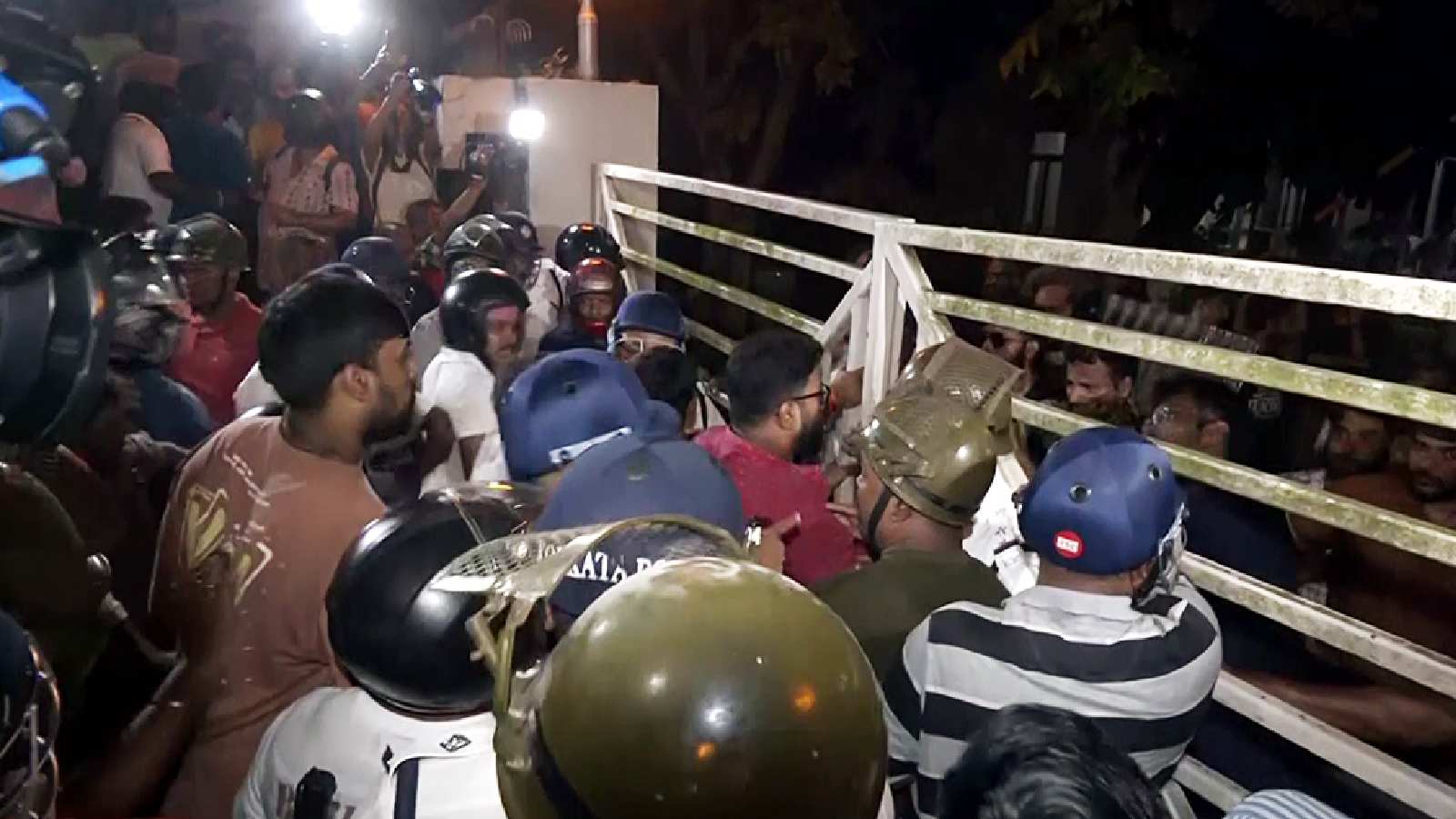


At Satyajit Ray Film and Television Institute in Kolkata, a programme organised by a consumer organisation ended in a clash between students and attendees. At Pune's FTII, students have repeatedly found themselves at the centre of political and ideological battles, from the appointment of Gajendra Chauhan to more recent disputes over film screenings and censorship.
The Film Institute is supposed to teach students filmmaking, so why do its students keep ending up in political clashes? Or, in simple terms, why are India’s film institutes unapologetically political?
The short answer is: Because cinema is political.
Even before the current culture-war vocabulary and social media expressionism, film institutions had a history of asking questions, protesting and expressing themselves.
FTII comes to the fore here. From its early years, the institute brought together filmmakers and teachers from very different traditions, including figures such as Ritwik Ghatak and Satyajit Ray, exposing students to competing ideas about cinema and society.
The question of who controls the space?
What happened at SRFTI recently was not just a clash, but a question over who gets to control the space. A confrontation during a programme organised by the consumer group Akhil Bharatiya Grahak Panchayat (ABGP), involving a section of students and members of the organisation, ended in a clash that made headlines.
The issue here revolves around who controls the space inside the institution
Who decides which organisations can hold events on campus? Who gets to speak there? And what happens when students believe that the presence of an outside organisation conflicts with the character of the institution?
Also, this is not entirely separate from the larger history of film institutes. These are spaces built around expression, ideas, and questioning; that is, arguments and disagreements over what to be shown, discussed, or expressed can quickly escalate into a political issue. And the question still persists about institutional autonomy.
According to PTI reports, the Akhil Bharatiya Grahak Panchayat (ABGP) had obtained permission to use SRFTI’s main auditorium for a consumer-awareness programme. Students alleged that they were called ‘anti-national ', ‘urban Naxals ', and ‘terrorists', and also complained that students, including girls, were attacked.
At the heart of the dispute was a deceptively simple question: who controls the space inside an institution?
An appointment and the screenings
In 2015, FTII Pune saw a major political and cultural battle after the government appointed actor and BJP member Gajendra Chauhan as chairman of the institute. What followed was protest, strikes and rebellion that lasted for 139 days. Students fiercely questioned the appointment and the selection process behind it.
But the dispute didn’t just end as a clash over appointment. It became a confrontation over political influence, institutional autonomy, and who gets to control one of the frontline institutions that shapes India’s filmmakers.
The government and Chauhan defended the appointment, while the protesting students and their supporters argued that the issue was not simply about one chairman or one appointment. For them, it was about creating an environment free from some influential politics.
In other words, the question was not simply ‘Who is Gajendra Chauhan? But it was ‘Who gets to decide who runs FTII?’
Then years later, in 2023, the question returned in another form. In January, some students screened BBC’s documentary on Modi, India: The Modi Question, a two-part BBC series examining Prime Minister Narendra Modi’s career and his relationship with India's Muslim minority, focusing heavily on the 2002 Gujarat riots. The FTII Student Association released a statement defending the screening, stating that banning media and literature leads to a declining society; hence, scrutiny has to be welcomed by elected leaders rather than hidden.
Then, in May, FTII became the site of another confrontation over a screening, this time involving The Kerala Story in FTII's main theatre by the MITEE Film Society. Several students protested outside the venue, calling out the film for spreading hate against Muslims and Kerala.
Police were deployed at the campus. The organisers, meanwhile, defended the screening and criticised the students' protest.
After each screening, the same question kept returning: who gets to decide what India’s future filmmakers should be allowed to see, question and create?
Why does cinema become political so easily?
Cinema is not just entertainment; it is a way of expression, rebellion, and revolution. It mirrors society through the visual medium of storytelling. And that is not limited by borders. It travels easily from person to person, and language seldom becomes a barrier.
Maybe that’s why film schools find everything political, every existence political.
A film can challenge what people believe about caste, religion, sexuality, nationalism, class, or even the government of the day. Sometimes the filmmaker does it deliberately. Sometimes a film becomes political simply because it depicts something society would rather not discuss.
Satyajit Ray is one of the filmmakers often remembered for the quiet humanism of Pather Panchali. His films, such as Aparajito and the Calcutta trilogy — Pratidwandi, Seemabaddha, and Jana Aranya — reflected the reality of Indian society, showcasing unemployment, political unrest, corporate culture, moral compromise, and a city undergoing profound change.
And none of this is a coincidence. In his interview published on satyajitray.org, he clearly states, “Have you seen Hirak Rajar Deshe (The Kingdom of Diamonds)? There is a scene of the great clean-up where all the poor people are driven away. That is a direct reflection of what happened in Delhi and other cities during Indira Gandhi’s Emergency. In a fantasy like ‘The Kingdom of Diamonds', you can be forthright, but if you’re dealing with contemporary characters, you can articulate only up to a point because of censorship. You simply cannot attack the party in power. It was tried in ‘The Story of a Chair’, and the entire film was destroyed. What can you do? You are aware of the problems, and you deal with them, but you also know the limit, the constraints beyond which you just cannot go.”
So when students at a film institute argue about what can be shown, who can speak, which organisation can enter the campus, or who should run the institution, they aren't suddenly importing politics into a place that was previously apolitical.
They are bringing into the classroom the same arguments that cinema has been having with society for decades. In that sense, they are following the footsteps of Satyajit Ray, who understood that looking closely at society is, in itself, a political act.
The state's cultural machinery
Institutes such as FTII in Pune and SRFTI in Kolkata are government-established institutions under the Ministry of Information and Broadcasting. There are also film-training institutions established or supported by state governments, such as Kerala’s K. R. Narayanan National Institute of Visual Science and Arts.
A protest or a clash in such institutes has a different impact than in private institutes. That means questions about appointments, administration, curriculum, regulation, funding, and institutional autonomy can quickly become political.
So, like the recent event, when students protest over a screening, an event, or an administrative decision, they aren't protesting in a vacuum or inside a random building. In fact, they protest inside institutions that are themselves part of the state's cultural machinery.
The fight is rarely only about the event. The event becomes a proxy for a much bigger argument about who controls culture.