

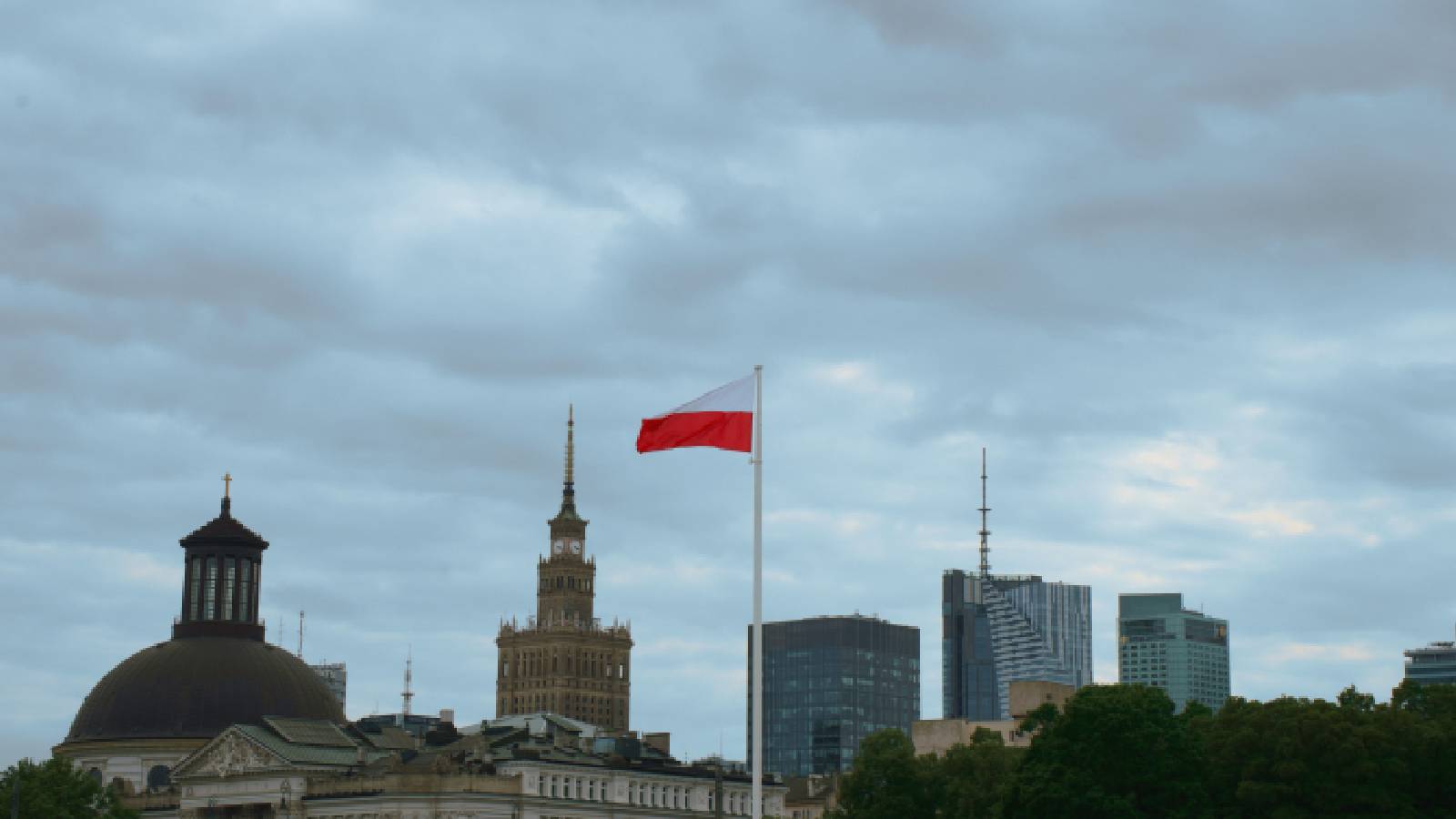


Warsaw: Poland's political and constitutional crisis escalated on Friday after police secured the Constitutional Tribunal in Warsaw amid protests over the suspension of its president, Bogdan Święczkowski, by a fellow judge. President Karol Nawrocki cut short his flight to Senegal, saying he needed to return to the country as tensions mounted.
Dozens of protesters gathered outside the court to demonstrate against what they viewed as the wrongful suspension of its leadership by the pro-European government of Prime Minister Donald Tusk.
Police said three people were detained after some protesters breached the Tribunal's fence and others threw objects at officers. Officers surrounded the premises in substantial numbers but did not physically enter the building, according to one account of the deployment. However, opposition politicians later alleged that security personnel had forced their way into the institution.
The confrontation followed a decision by Judge Anna Korwin-Piotrowska to suspend Święczkowski and his deputy, Bartłomiej Sochański, for one month. The suspensions reportedly stemmed from allegations that the two officials had improperly discharged their duties and prevented legally appointed judges, including Korwin-Piotrowska, from participating in the Tribunal's proceedings.
The court's website published information about Święczkowski's suspension around 6 pm local time before going offline. The Associated Press said it could not independently verify the official reasons given for the suspension. The Tribunal subsequently claimed on social media that its website had been subject to an "illegal takeover", arguing that Korwin-Piotrowska lacked the authority to speak on behalf of the court. It also warned that those involved were "committing the crime of coup d'état".
The dispute reflects a wider struggle over the composition and independence of Poland's judiciary, particularly the Constitutional Tribunal, between Tusk's pro-European administration and the national-conservative Law and Justice (PiS) party, which governed from 2015 to 2023.
Critics in Poland and the European Union have accused the previous PiS government of imposing political control over key judicial institutions. Its judicial reforms led the EU to impose fines on Poland.
Tusk's government came to power in 2023 promising to restore judicial independence. However, its efforts have faced resistance from two successive presidents aligned with PiS, including Nawrocki, who has used presidential vetoes to block parts of the government's agenda.
The current dispute has also centred on appointments to the Tribunal. Tensions intensified after Nawrocki declined to administer oaths to three of six judges selected by Parliament. The Tusk administration has questioned the legitimacy of rulings by judges appointed under the previous PiS government, while Nawrocki and Święczkowski have refused to recognise magistrates selected by the Sejm in 2026.
Korwin-Piotrowska has been at the centre of the disagreement, with Nawrocki previously rejecting her oath of office and Święczkowski blocking her participation in hearings.
Tusk defended his government's actions, saying the restoration of the rule of law was an obligation despite the difficulties involved.
"Restoring the rule of law is our obligation. After years of lawlessness under PiS, this is a difficult process, sometimes painful, and it requires decisive action. There is no other way," he wrote on X on Friday evening.
Nawrocki, meanwhile, announced that he was returning from his trip to Senegal.
"At a moment like this, the President must be in Poland. I am cutting short my flight to Senegal. I am returning," he wrote on X. His chief of staff said the President was scheduled to consult Supreme Court President Kapiński after returning, over the attempted suspension of the Tribunal's president.
PiS politicians strongly condemned the suspension. Former Justice Minister Zbigniew Ziobro described it as a "blatant, criminal attack on the constitutional order" and called for resistance.
PiS leader Jarosław Kaczyński accused the Tusk administration of using state institutions against the Tribunal, warning that Poland was moving towards authoritarianism.
"From today, Poland becomes a police state, and from there there is already a direct path to authoritarianism, and then to totalitarianism," he said.
European Parliament members associated with PiS also criticised the developments. MEP Arkadiusz Mularczyk described the situation as a coup d'état, alleging that government agents had unlawfully entered the Tribunal to prevent judges from accessing the premises. Former prime minister and MEP Beata Szydło likewise accused the Tusk government of sending police to force their way into the independent court.
Meanwhile, Poland's Ambassador to China, Jakub Kumoch, resigned on Friday evening, saying that "in light of the events in the country", it was no longer possible for him to continue in his diplomatic post.
The latest confrontation marks a further escalation in Poland's prolonged institutional deadlock, with the government and opposition offering sharply conflicting accounts of the legality of the suspension and the status of the Tribunal's leadership.
(With agency inputs from ANI and AP via PTI)