

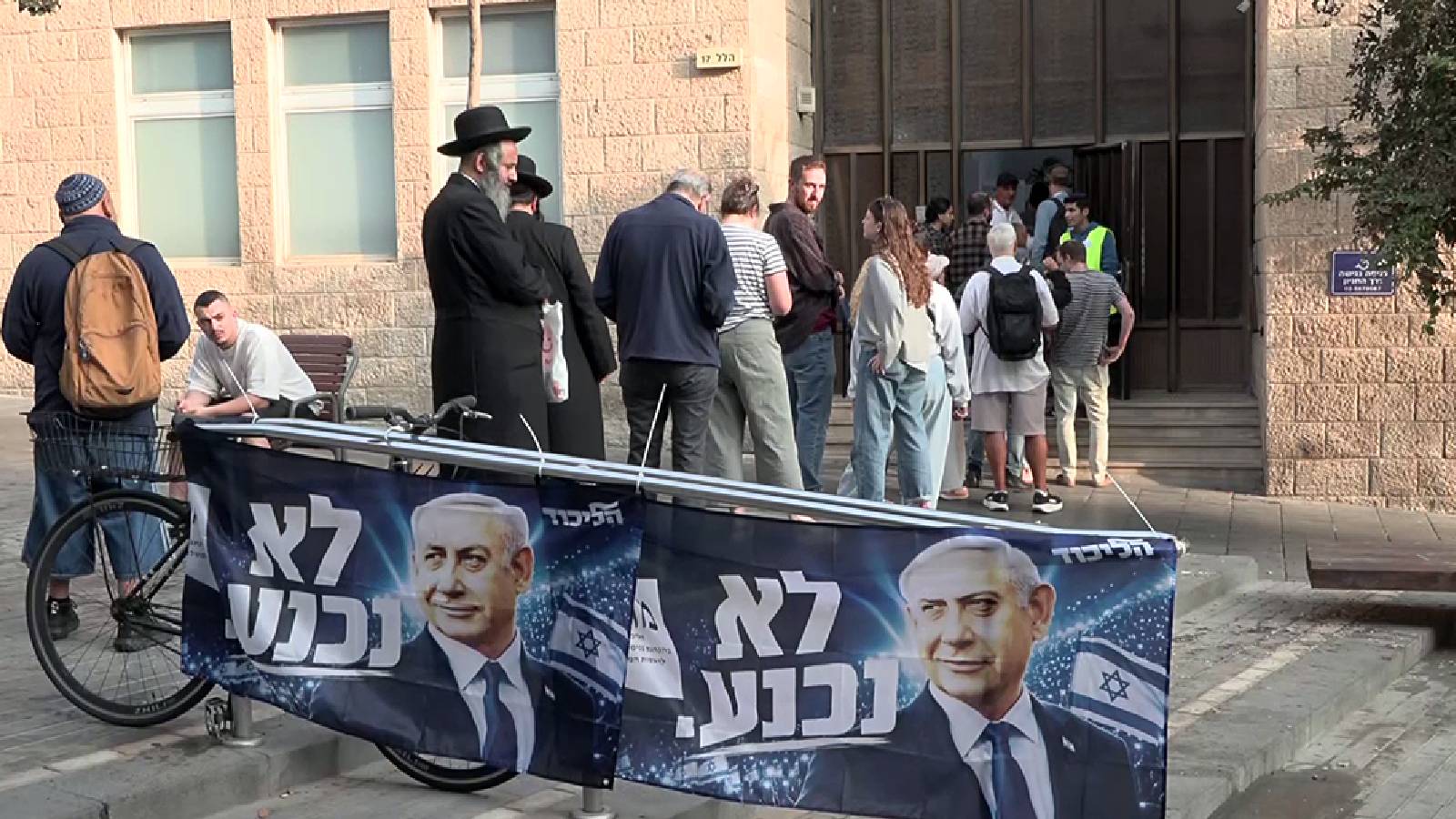


Tel Aviv: Israeli Prime Minister Benjamin Netanyahu on Friday reiterated his opposition to forming a government with Arab parties, even as the country's parliamentary election left his bloc short of a majority and coalition negotiations set to determine the next government.
In a post on X, Netanyahu shared a video compilation of remarks by Arab political leaders and opposition lawmakers, including Ahmad Tibi, Iman Khatib-Yasin, Mansour Abbas, Sami Abu Shehadeh, Ofer Cassif, Yousef Jabareen and Ayman Odeh. The leaders are heard expressing support for the Palestinian cause, positions that right-wing Jewish factions view as anti-national.
"It is forbidden to form a government with them," Netanyahu said, reiterating his opposition to relying on Arab parties to form a coalition.
The uncertainty in government formation
The final results published by Israel's Central Elections Committee (CEC) on Friday confirmed that Netanyahu's Likud-led bloc secured 53 seats in the 120-member Knesset, eight short of the 61 required for a parliamentary majority. The opposition bloc won 48 seats, while the Arab-led parties secured the remaining 19.
Likud emerged as the largest party with 27 seats, followed by Gadi Eisenkot's Yashar with 21 and Naftali Bennett's B'Yachad with 12. The Joint List won 11 seats, while the Democrats and Ra'am secured eight each. Yisrael Beytenu, United Torah Judaism and Otzma Yehudit won seven seats apiece, while Shas and Religious Zionism secured six each.
The results leave government formation uncertain, particularly as Netanyahu has ruled out cooperation with the Arab-led parties whose combined seats could prove decisive. The Haredi parties, United Torah Judaism and Shas, have also indicated that they want to be counted separately rather than as part of the Netanyahu bloc, according to reports in Israeli media.
‘A win is a win’
Netanyahu and Finance Minister Bezalel Smotrich, who leads Religious Zionism, have reportedly met to coordinate their efforts following the election.
Meanwhile, Opposition Leader Yair Lapid declared a victory for the anti-Netanyahu camp, arguing that the prime minister had no viable path to forming a government.
In a post on X, Lapid pointed to the election turnout of 77.9 per cent, the highest in decades, and said Netanyahu's bloc had secured only 53 seats.
"So we won. It's not a knockout victory. It's a points victory. That counts too. A win is a win," he added.
Lapid acknowledged that forming a government would be difficult but said the opposition had an obligation to try to build a coalition. He urged supporters to remain patient as negotiations begin.
Eisenkot seeks to build an alternative coalition
Eisenkot, a former military chief and leader of Yashar, also said he would make every effort to form a "Zionist government" with national service for all. He called on Netanyahu to step down, arguing that the outgoing coalition had lost public trust. Eisenkot has indicated that he is open to cooperation with Arab-led parties, subject to conditions.
The election outcome has also been clouded by allegations of electoral fraud and foreign interference raised by Netanyahu and Likud. The party has sought investigations into alleged bribery, threats, violence and multiple voting, claiming that the election was "stolen".
However, acting CEC Director General Dean Livne rejected allegations of systematic violations, saying the election had been conducted lawfully and that the integrity of polling stations had been safeguarded.
In a letter to Yesh Atid lawmaker Vladimir Beliak, Livne said there was no basis, to the best of the committee's knowledge, for claims of systematic violations of election integrity. He also told Channel 12 News that allegations of foreign influence would not affect the results unless direct evidence was found.
The CEC reiterated that its investigation into suspected foreign interference would not alter the final results. Livne described reports suggesting otherwise as "entirely unfounded".
Israel's domestic intelligence agency, the Shin Bet, said its investigation into suspected foreign interference was limited in scope and based on its own intelligence collection, rather than information provided by any political party or actor.
Influence through foreign funding?
The agency confirmed that its chief, David Zini, had briefed Netanyahu, Lapid and Eisenkot on the main suspicions under investigation. The briefing followed a request by CEC chairman Justice Noam Sohlberg for an investigation into suspected improper influence through funding from foreign entities allegedly acting against Israeli interests.
Hebrew-language media reports said Likud suspected Qatar might have funded organisations involved in mobilising Arab voters. Some reports also mentioned Turkiye as a possible source. Qatar rejected the allegations as "ridiculous and dangerous", while Turkiye called claims of its involvement "entirely baseless".
Police have also disputed Likud's broader claim that the election was stolen. A police source told Hebrew media outlets that election day had passed with very few incidents concerning electoral integrity and that there was no investigative or intelligence-based substantiation for claims that the vote had been stolen.
The role of Arab parties in government formation
Netanyahu's opponents have accused him of using the allegations to delegitimise Arab voters and undermine the election outcome. Yair Golan accused the prime minister of pursuing what he described as an "ugly delegitimisation campaign" against the public and Arab voters in particular.
The Arab-led Joint List also accused Netanyahu of attempting to steal the election, while Ra'am leader Mansour Abbas welcomed the investigation into possible foreign interference and denied his party's involvement. He also accused the prime minister of incitement.
President Isaac Herzog described the situation as a "sensitive moment" and called for a full investigation, while cautioning against targeting an entire community.
"We must not tarnish an entire community that sought to exercise its right to vote and take an active part in democracy," Herzog said. He also urged party leaders to avoid another election.
The newly elected Knesset is scheduled to be sworn in on November 10, regardless of whether a new government has been formed.
Arab-led parties primarily represent Palestinian citizens of Israel, who account for about a fifth of the country's population. Their 19 seats could influence government formation and parliamentary proceedings, even if they do not join a coalition.
Ra'am's participation in the government formed in 2021 under then-prime minister Naftali Bennett and Lapid marked the first time an Arab party became part of an Israeli governing coalition. That government collapsed in 2022, triggering another election.
The latest vote follows years of political instability in Israel, which held five elections between 2019 and 2022.
(With agency inputs from ANI and PTI)