

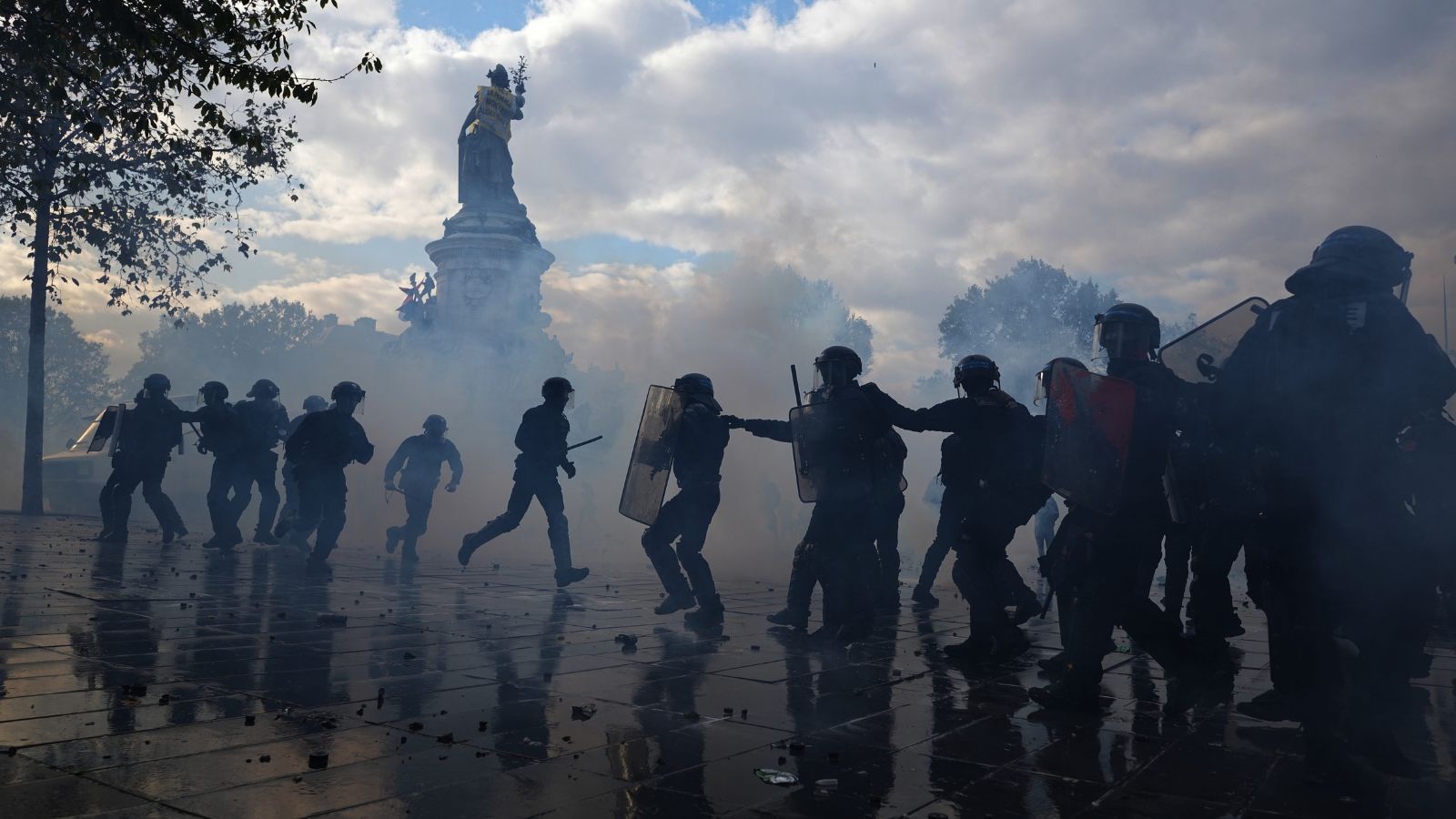


Paris: Around 110,000 people took to the streets of Paris on Saturday to protest against rising living costs and demand better school funding, as police fired tear gas and used water cannons amid demonstrations across France.
The march in the French capital began peacefully but ended amid rain and clashes, with authorities restricting the route away from the city centre. The demonstrations marked an escalation of a movement that began with students protesting school conditions, teacher shortages, class schedules and inequalities between public and private education.
French Interior Minister Laurent Nunez said 135 people had been arrested nationwide by early afternoon. Police seized items including fireworks, ball bearings, slingshots, airsoft guns, improvised weapons and a Japanese katana sword during searches, according to French media reports.
Authorities deployed around 70,000 police officers across the country to prevent a repeat of the riots and looting that erupted during protests the previous weekend. Nunez said there had been no major incident at the time of his remarks, while Paris police described the atmosphere in the capital around midday as calm.
Protests spread across French cities
Lyon witnessed clashes as police fired tear gas to disperse groups of demonstrators. Thousands also gathered in Marseille and Lille, while trade unions, student groups, activists and civil society organisations joined the wider mobilisation.
The protests have expanded beyond student demands, drawing in trade unions and the Yellow Vests movement amid public anger over the cost of living and purchasing power. Housing affordability and economic pressures have also fuelled demonstrations in other European countries.
French authorities had banned planned demonstrations in Marseille and Lyon and closed major museums in Paris ahead of Saturday's rallies as part of efforts to contain unrest.
The Paris police prefecture had also changed the planned route of a march from Place de la Bastille to Place de la Nation, proposing a route from Porte d'Italie to Porte de Vincennes instead. The change drew criticism from left-wing leaders and trade unions, who warned it could create confusion and complicate security arrangements.
Marine Tondelier, leader of the Ecologists, described the situation as concerning, while La France insoumise leader Jean-Luc Mélenchon accused authorities of disrupting the marches. Union representatives also questioned whether the revised route could be secured effectively.
Far-right National Rally convention draws counterprotests
Meanwhile, the far-right National Rally party, led by Marine Le Pen and Jordan Bardella, held its convention in Orléans, south of Paris, drawing supporters and counterprotesters.
Local authorities reported that around 11,000 protesters had gathered in the city by noon. Demonstrators carried banners and chanted slogans against the far right and President Emmanuel Macron, as left-wing leaders, trade unions, students and activists joined the mobilisation.
Bardella was re-elected president of the National Rally during the convention, which comes about six months before France's presidential election. Party supporters gathered at the Zénith arena, chanting slogans backing Le Pen's presidential ambitions.
The demonstrations have placed fresh pressure on Macron's government, which has sought to prevent further violence following last week's unrest. Macron convened a defence council meeting with senior ministers and officials amid the security concerns and was scheduled to meet security forces.
Macron has called for the utmost severity against delinquency and accused far-left groups of undermining the republic. Justice Minister Gérald Darmanin said courts had sentenced 217 people, around half of them first-time offenders, to prison in connection with the previous week's violence.