

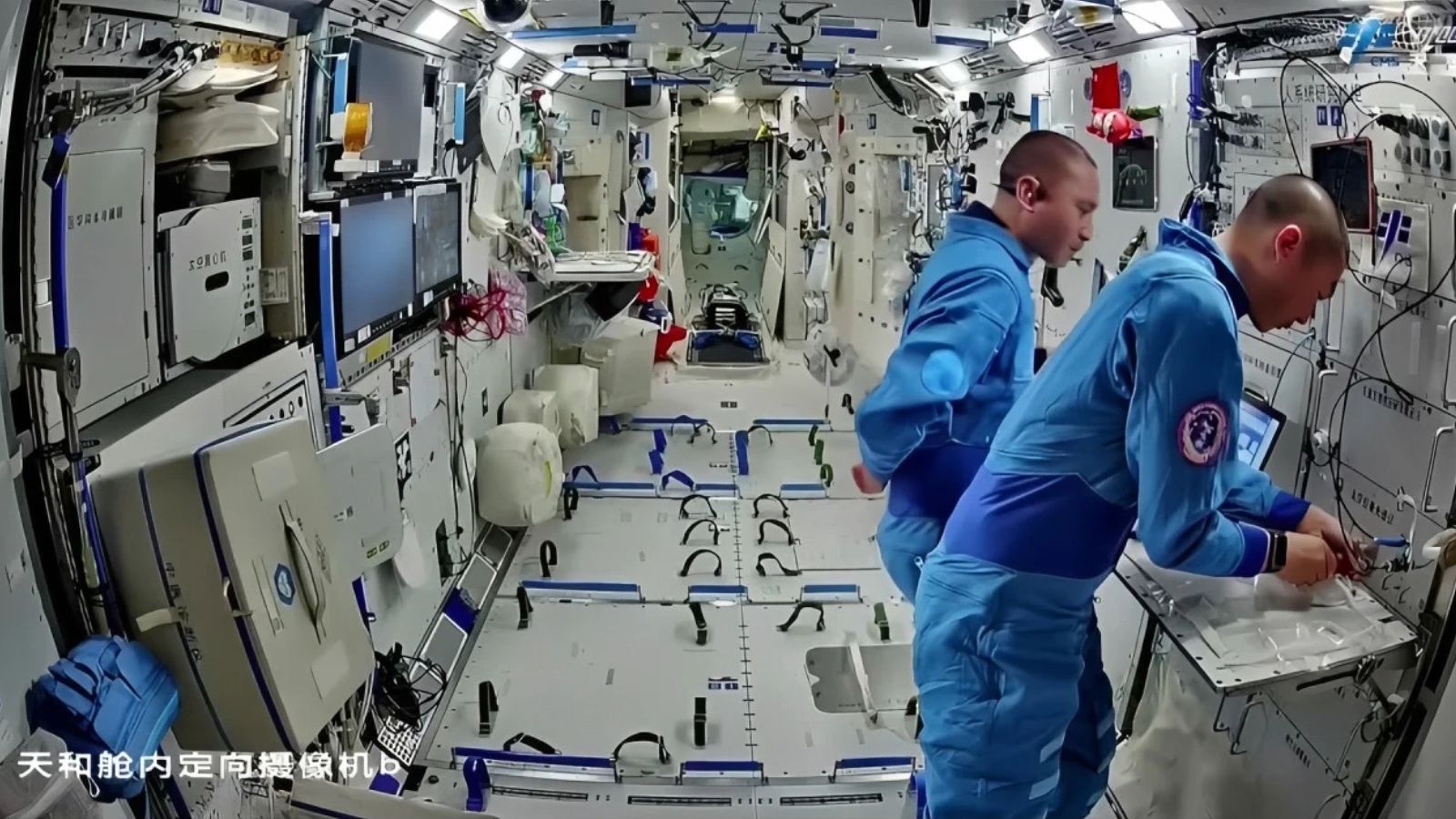


The Shenzhou-23 crew aboard China’s Tiangong space station carried out space science experiments, station maintenance and health checks over the past week, according to the China Manned Space Agency (CMSA).
Commander Zhu Yangzhu and his crewmates Zhang Zhiyuan and Lai Ka-ying were launched aboard the Shenzhou-23 spaceship late on May 24 and have been in orbit for more than four months.
Over the past week, the crew used a space Raman spectrometer to analyse metabolic components in urine samples and conducted research into microbiota and nutritional metabolism. They also carried out planned studies on brain activity and human-machine adaptation during multi-tasking scenarios.
The astronauts adjusted cabin lighting as part of performance tests examining how the lighting environment affects psychological perception and work efficiency.
In microgravity physical science, the crew installed an inertial particle experiment module in the online maintenance and adjustment control cabinet. They also replaced samples in the fluid physics experiment cabinet and maintained the electrodes for the axial mechanism.
Alongside their scientific work, the three astronauts inspected and maintained the space station’s life support system, replacing relevant components as scheduled. They also carried out routine cleaning of the cabin environment.
The crew completed medical examinations that included neck ultrasound scans, bone density measurements, intraocular pressure and fundus examinations, as well as body mass measurements.