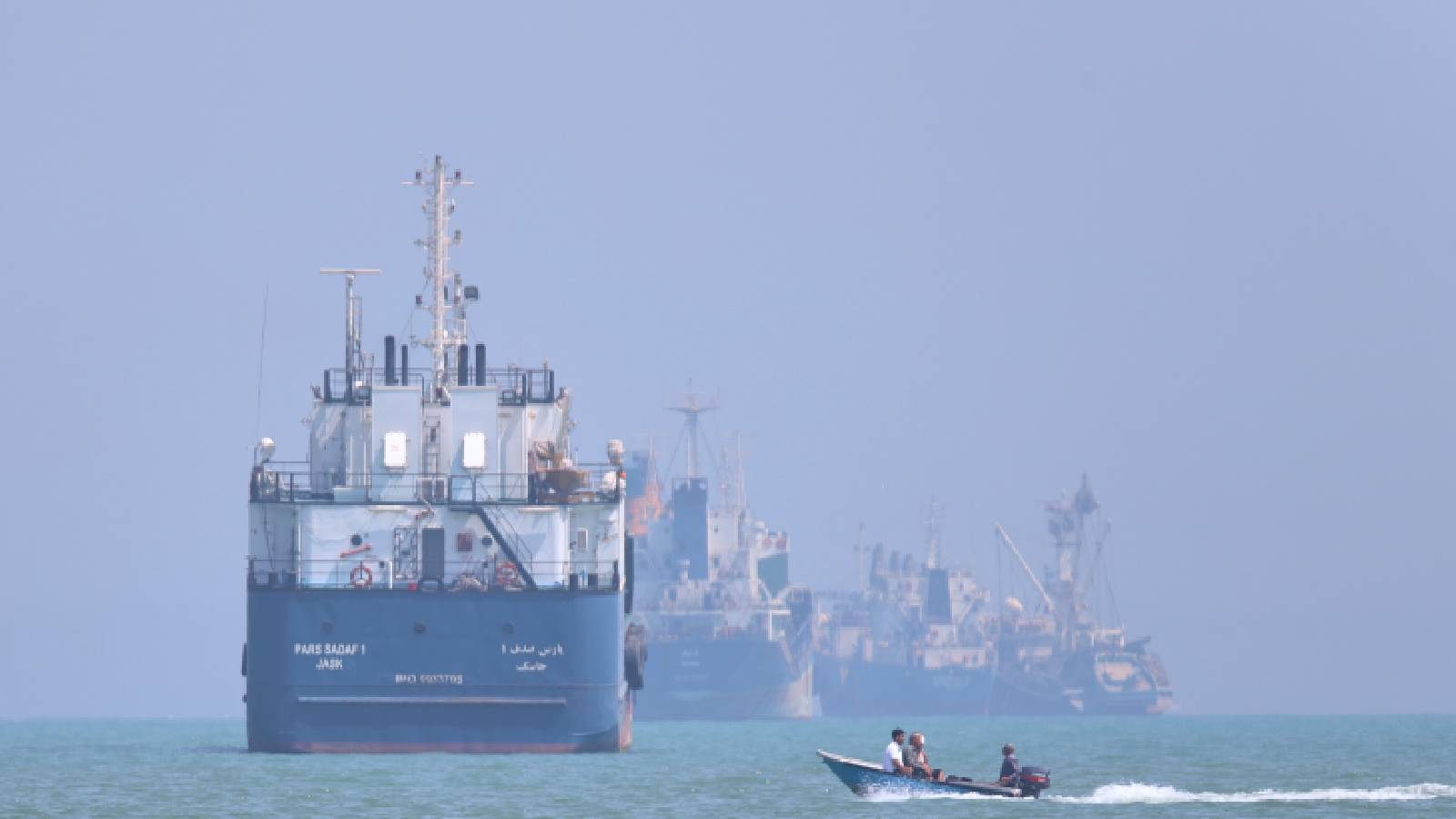


The US military said Friday that it fired on another merchant vessel that was trying to breach its blockade of Iranian ports, while Iran targeted American strongholds around the Persian Gulf.
The US and Iran showed no sign of backing away from their conflict after a 13th straight night of strikes. With fighting flaring again and diplomacy uncertain, both sides made moves suggesting an escalation was possible. US embassies in the Middle East began alerting Americans in the region that options to leave could become more limited, while Iran's Revolutionary Guard advised residents of neighbouring countries to stay away from bases with US troops.
Meanwhile, Saudi Arabia struck the port city of Hodeida in Yemen in response to Iranian-backed Houthi rebel attacks on Saudi oil tankers in the Red Sea, the Saudi-led coalition in Yemen said early Saturday. The Houthis said the group would escalate after tensions have been brewing for weeks, breaking a yearslong calm.
American forces disabled the M/T Lavine in the Gulf of Oman after the ship attempted to run the blockade at least four times, Capt Tim Hawkins, US Central Command spokesman, told The Associated Press. Hawkins stressed that the ship's crew was warned and didn't comply with commands. The military then fired into its engine room. It's the second commercial ship to be disabled since the military reimposed its blockade. US Central Command said it also has redirected 12 vessels.
The same day the naval blockade was reimposed, the US military said it opened fire on the Curacao-flagged oil tanker Belma sailing toward Kharg Island, Iran's main oil export terminal in the Persian Gulf. After the ship “ignored multiple warnings,” a US aircraft disabled the merchant vessel by firing a missile into the ship's smokestack on July 15.
Earlier on Friday, US President Donald Trump described negotiations with Iran as “by far the most serious that we've seen,” even as the US has launched daily strikes. Trump added that he's “not in a hurry” to end the war.
Vowing that Iran “will not bow to US” bullying, Iranian Foreign Minister Abbas Araghchi noted ongoing discussions with two global powers often at odds with Americans — China and Russia — and warned in an interview with the semiofficial news outlet Tasnim that the Islamic Republic is “neither intimidated by threats nor will we yield to pressure.”
At the centre of the fight is the Strait of Hormuz, a crucial passage for world energy supplies that has been effectively shut down by Iranian attacks, sending fuel prices soaring and causing widespread economic turmoil.
US strikes sites across Iran and countries in the region are targeted
In the northern Iraqi city of Irbil, which is home to a contingent of American military advisers, security officials said Friday that US-led forces had shot down five explosive-laden drones. Repeated blasts echoed in Irbil, the capital of Iraq's semiautonomous Kurdish region, and plumes of black smoke were seen near its airport, where US forces are based. US military officials did not respond to a request for comment on the apparent attacks.
Meanwhile, Iran's Revolutionary Guard said it had targeted the US base in Udairi, Kuwait, setting ablaze and destroying three ammunition and storage sheds. It also claimed to have struck a watchtower for the US Navy's Fifth Fleet, based in Bahrain, which it said was damaged.
US Central Command did not respond to inquiries about the claims.
Both Bahrain and Jordan said they had intercepted aerial attacks by Iran on Friday.
As a barrage of assaults was aimed at bases of the United States and its allies, the US hit a Revolutionary Guard naval base in northern Iran, according to the semiofficial news outlets Fars and ISNA. Blasts from US bombardment were also reported on Iran's Qeshm Island, a base for naval assets including drone boats that Iran can use to attack vessels in the strait, as well as in Isfahan province, home to a major Iranian air base and one of Iran's nuclear sites.
Additional strikes reportedly hit Iran's southwest Khuzestan province and southern Fars province.
Central Command said the latest barrage was designed to “further degrade Iran's ability to threaten civilian mariners and commercial vessels transiting regional waters” as the Americans push to reopen the strait, through which one-fifth of the world's oil and gas transited in peacetime.