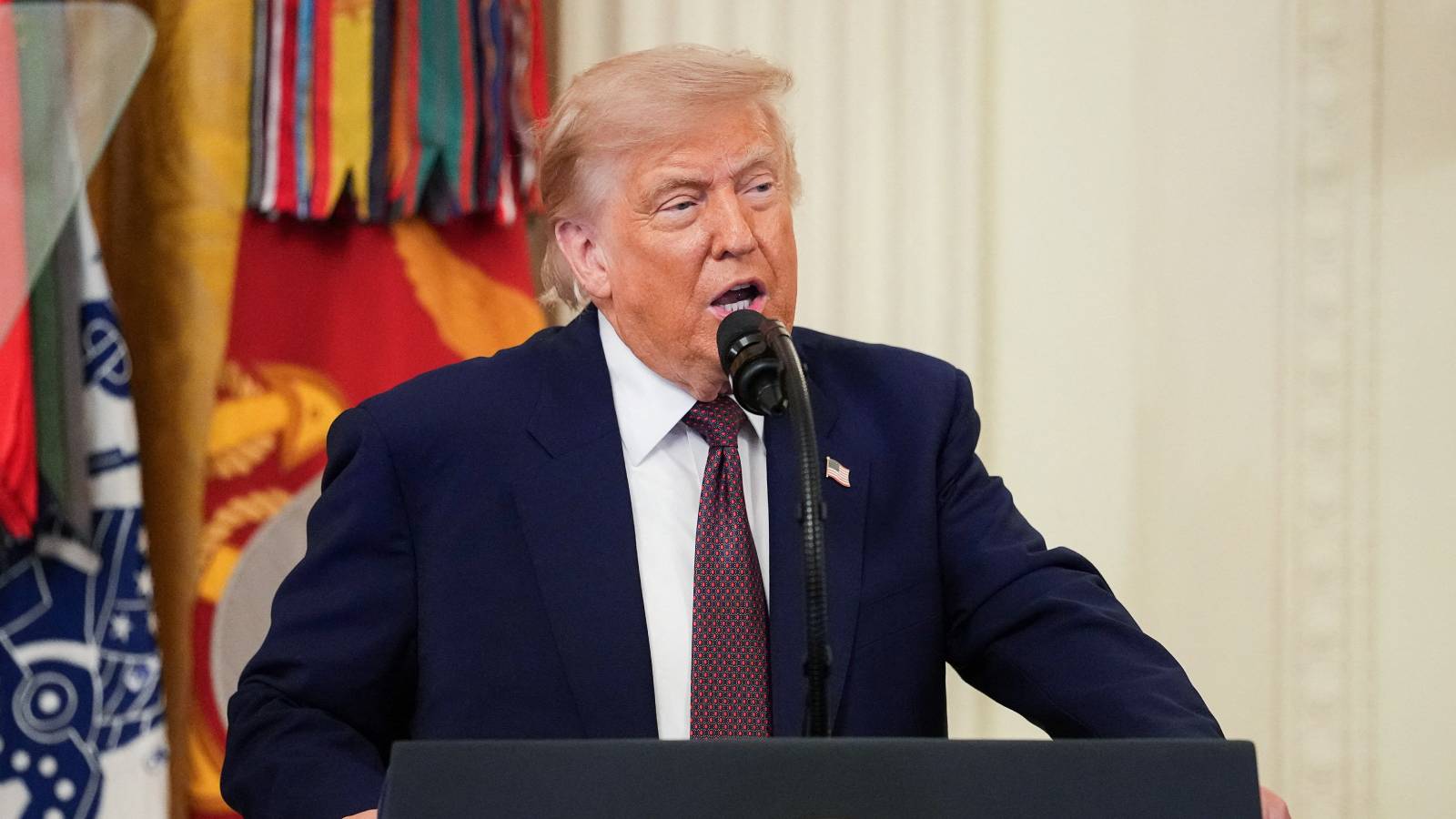


Washington: Amid escalating tensions in West Asia, US President Donald Trump said on Tuesday that the United States would strike the Pickaxe Mountain area, located near Iran's heavily damaged Natanz uranium enrichment facility, "pretty soon."
Pickaxe Mountain is a heavily fortified site that houses two deeply buried tunnel complexes which experts believe are beyond the reach of even the most powerful bunker-buster bombs in the US arsenal. The facility is believed to be linked to Iran's nuclear programme.
Trump also said the US has no interest in resuming peace talks with Iran at this stage.
"I will tell you, they want to desperately meet. And until they're ready to meet in a meaningful way, we have no interest in meeting," Trump told reporters in the Oval Office.
He claimed that, through back-channel communications, Iranian officials had conveyed that "they want to meet desperately to try and end it, because they're getting decimated."
The latest remarks came as tensions between Washington and Tehran escalated following the collapse of the interim agreement that had aimed to end the conflict.
Iran attacked a tanker in the Strait of Hormuz early Tuesday, forcing its crew to abandon the vessel, while the United States carried out another round of airstrikes targeting sites in Iran as both sides continued to battle over control of the strategically important waterway.
Ten consecutive nights of US airstrikes have failed to force Tehran to loosen its grip on the Strait of Hormuz, through which roughly one-fifth of the world's seaborne crude oil and natural gas trade passes during peacetime.
Even as the two countries move closer to another full-scale conflict, Iran's interior minister travelled to Pakistan, a key mediator, for talks. However, it remains unclear whether any diplomatic breakthrough can halt the fighting.
The interim deal signed last month has effectively collapsed, shipping through the Strait of Hormuz has slowed dramatically, and both sides have increasingly targeted civilian infrastructure relied upon by millions of people.
"Iran and groups supportive of Iran may target other US interests overseas or at locations associated with the United States and Americans throughout the world," the US State Department warned in a fresh advisory.
The US military's Central Command (CENTCOM) said it had targeted Iranian military command centres, maritime capabilities, missile and drone launch sites, and air defence systems. It also released footage of the strikes.
"American forces remain postured and prepared to hold Iran accountable for unwarranted aggression toward civilian mariners seeking to freely and openly transit the strait," CENTCOM said.
Iranian state media reported explosions in the provinces of Fars, Hormozgan, Ilam, Kerman, and Sistan and Baluchistan.
Maritime traffic through the Strait of Hormuz has slowed sharply amid the escalating conflict. According to Lloyd's List Intelligence, only three ships transited the waterway on Sunday.
The British military's United Kingdom Maritime Trade Operations (UKMTO) said a tanker came under attack early Tuesday in the Strait of Hormuz off the coast of Oman, forcing the crew to abandon the vessel.
Iran's Islamic Revolutionary Guard Corps (IRGC) claimed responsibility for that attack, as well as two other attacks on ships on Monday in the strategic waterway.
The route along Oman's coastline has been recommended by the US military for commercial vessels seeking to avoid Iranian-controlled waters. UKMTO also reported another previously undisclosed attack on a ship that occurred early Monday.
Iran also launched attacks targeting US allies across the Middle East. Jordan's military said Iran fired five drones and three missiles toward its territory, all of which were intercepted. Bahrain also activated missile warning sirens on Tuesday afternoon as another wave of Iranian missiles targeted the island nation, which hosts the US Navy's Fifth Fleet.
(With inputs from Reuters, AP via PTI)