

“If football and table tennis had a kid, it would be called Teqball.”
That is how Quimcy D’Souza explains the sport that she introduced to a much wider Indian audience at the Asian Games 2026.
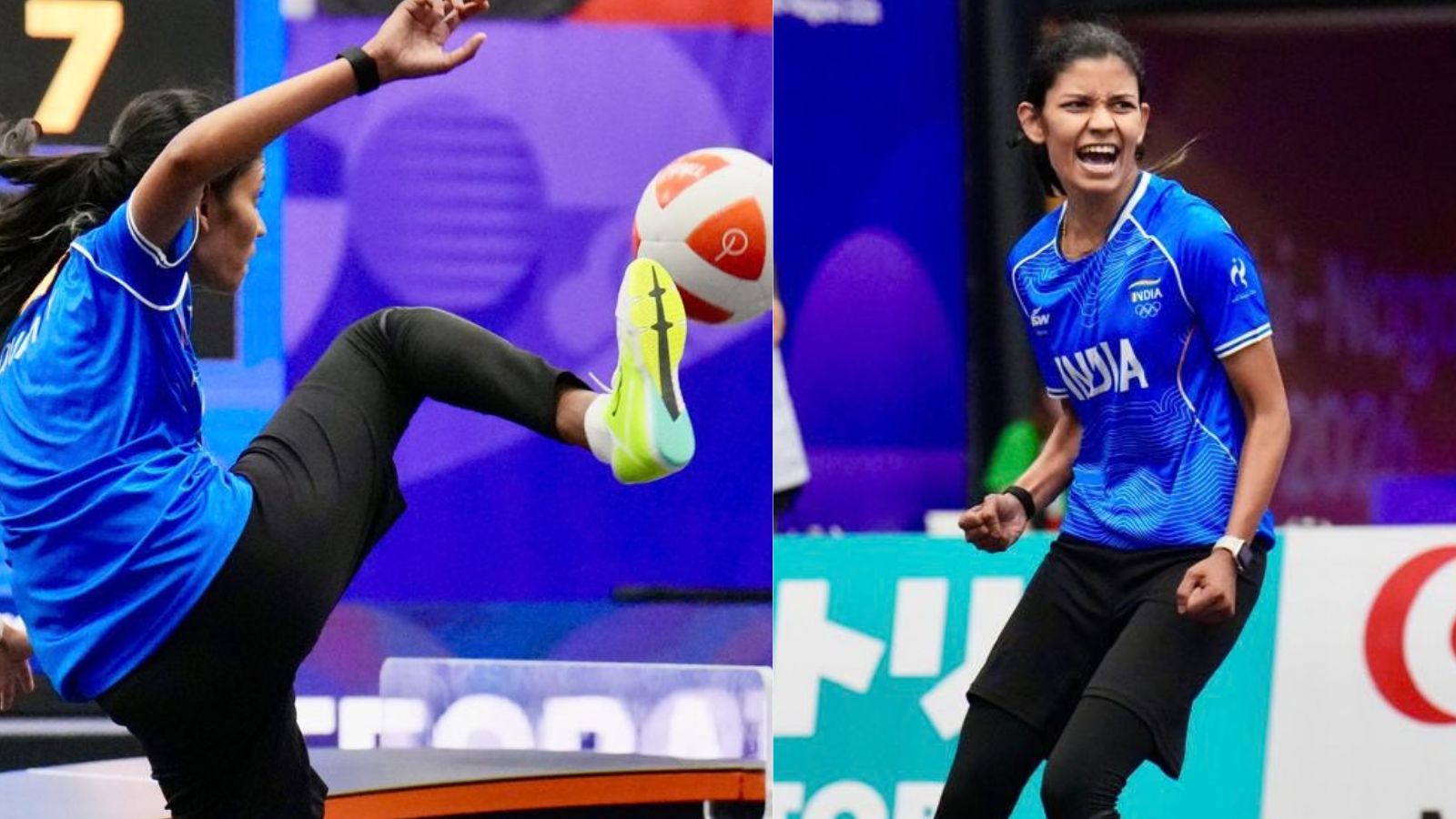
Teqball made its Games debut in the spotlight in Nagoya, and D’Souza quickly became one of the faces of India’s campaign. Although she missed out on a medal, her run to the women’s singles semifinals has generated curiosity around a sport that remains relatively unfamiliar to many in the country.
D’Souza began her campaign with a major upset, stunning top seed Yuina Sakamoto of Japan 2-1 (10-12, 12-11, 13-11) in her opening Group A match. She followed that with a 2-0 win over Cambodia’s Kemyean Dy (12-9, 12-7) to progress to the knockout stage. D’Souza eventually reached the semifinals, where she lost to Indonesia’s Sumaya, before suffering another defeat in the bronze-medal match.
“It was a little heavy on the chest, I think," D'Souza said after missing out on a medal. "It was not an easy one to digest. But in terms of popularity, I think we got there, and that feels a little better. But in terms of the medal, it still feels bad."
For D’Souza, the Asian Games may not have ended with the medal she wanted, but it gave Teqball something equally important: attention.
What is Teqball?
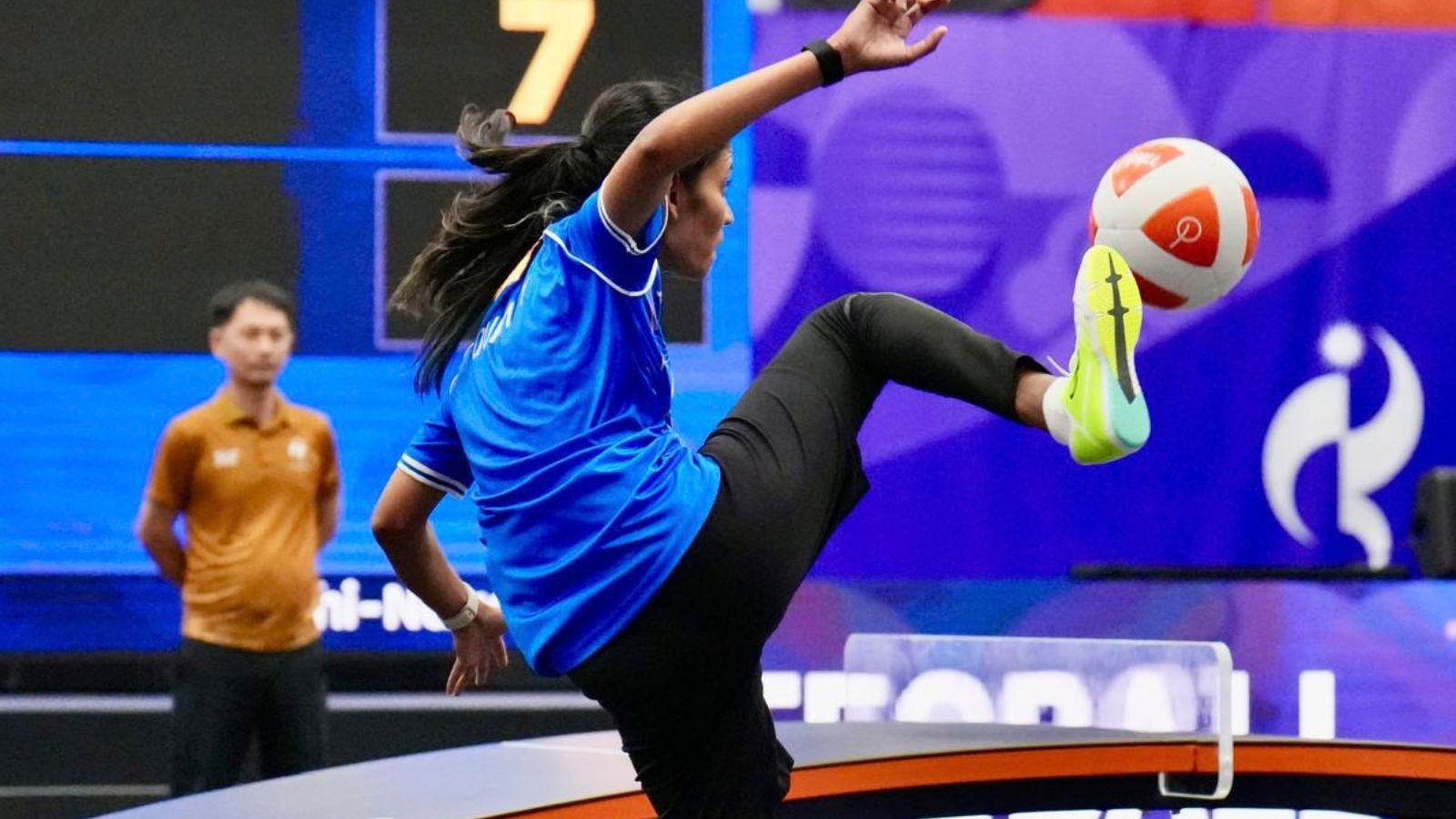
Teqball originated in Hungary a little over a decade ago and combines elements of football and table tennis. Players cannot use their hands or arms; instead, they use other parts of their body to control the ball and return it over a curved table. D’Souza has her own simple way of describing it. “We made a definition for it. So, if football and table tennis had a kid, it would be called Teqball,” she said.
Teqball combines elements from football, table tennis, tennis and volleyball, and is played over a curved table. “You have a table tennis ball, but it’s a size-five ball, which is called a Teqball. Instead of rackets, you use your body parts without using your hands.
“You can use a maximum of three touches and a minimum of one. When you play doubles, you and your partner both have to touch the ball. It’s a combination of tennis because you have two serves; it’s a combination of volleyball because you can do three touches; table tennis because you’re playing over a table; and football because you cannot use your hands and it’s all about control.”
For D’Souza, Teqball was not something she had planned to pursue. It found her at a time when she was trying to find a way to stay connected to sport.
From football to Teqball
D’Souza was a football player and had represented Maharashtra at the under-19 level. But an injury changed the course of her sporting career.
“I got a ligament injury and couldn’t continue football. The doctor said I couldn’t play football as I used to, or at 100 per cent, because there was always a chance of injury,” she said. She pursued a degree in sports management, believing she could contribute to sport away from the playing field. Then she saw a video that changed everything.
“While I was doing my degree, I came across Teqball on Instagram through Ronaldinho, as most people know now,” D’Souza recalled. “I searched on Google, and since I was from Mumbai, I looked for people who played the sport. Luckily, I found a few people. There was a table back in Mumbai at that time, and that’s how we started playing on the table.”
“There was no coach. We started by ourselves, just a couple of friends playing. When I took my first touch on the table and was able to return the ball for the very first time- not everybody can do that- I felt it was for me.
“I said, ‘Okay, everything is just working out’.”
That first touch eventually turned into a career. D’Souza went on to compete at the national level and is now a seven-time national champion. She has also competed in around 20 international tournaments. But nothing quite compared to the attention she received at the Asian Games.
D’Souza returned from Nagoya to a reception that showed just how much her Asian Games run had changed the perception of her sport.
“I think it started right from the airport when my entire family and friends were there to receive me. It’s a big thing for them as well, for them to digest the fact that the entire country now speaks about their daughter or their friend,” she said.
“So they were quite happy. It was quite welcoming, to be honest. For the world, it was a good achievement. For me, it was not. So, I’m still in the zone, but I’m not happy about it. But I think it will stay for a while until I get my next medal back.”
That hunger is perhaps what has taken D’Souza this far, and when she talks about where that competitive spirit comes from, she points to her father. "He always told me that I had his sporting genes." “If there was one person who I always looked up to and always wanted to be like, and have the same passion as, it would be my dad,” D’Souza said. “He was mad about sports.”
“No doubt, since childhood, I loved competing. I loved it. I’m very aggressive when I play. I’m very competitive that way. So, I think my inspiration and motivation has always been my dad.” Now, with Teqball gaining visibility in India, D’Souza hopes her Asian Games campaign can help create opportunities for more players. The challenge, however, remains funding.
Also Read:
D’Souza has a packed schedule ahead, with four major competitions before the end of the year. But even after making history at the Asian Games, financial support remains a concern. “There are four big tournaments coming up now before December. The first one is the World Series happening in Thailand in October. Then you have the Nationals in November, the World Championships in November and the Asian Indoor Games happening in Riyadh in December,” she said.
“We do not know what the pathway looks like. I just know I have to participate in all four tournaments coming up. Again, for Thailand, it’s going to be self-funded, sadly. We really need to look at how we’re going to do this and how we’re going to pull it off.” “Since we have no coach, I think the hunger now is immense. So, we are all going to get back on our feet in a day or two and get back to training.”
The medal may have eluded D’Souza in Nagoya, but her Asian Games journey has already achieved something significant: people talking about Teqball. And for a sport that is still fighting for recognition in a cricket-dominated country, it could be the beginning of something much bigger.