

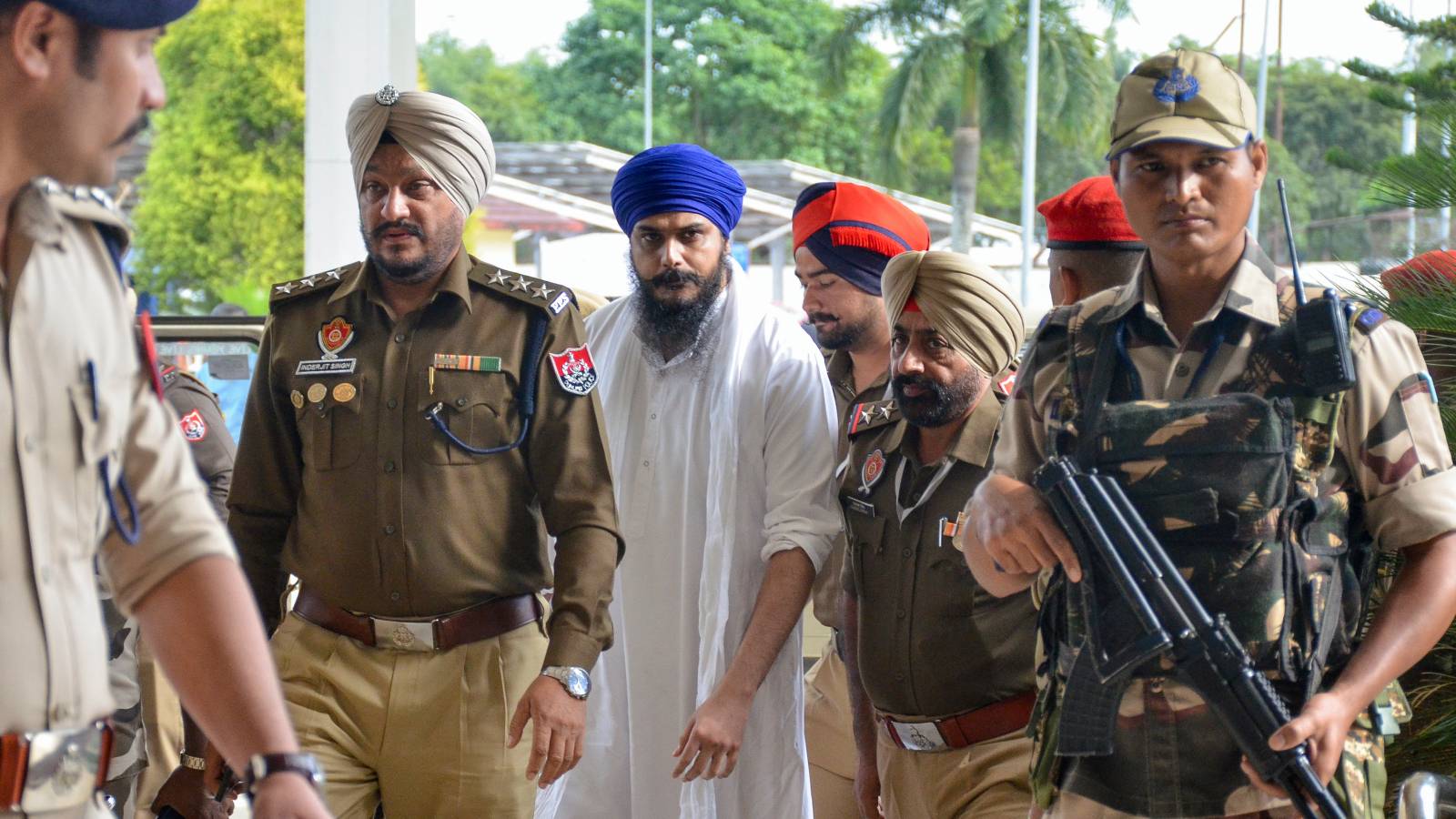


Chandigarh: Amritpal Singh's three-hour parole on November 21 to attend his grandmother's cremation comes at a politically significant moment for Punjab.
The jailed Khadoor Sahib MP, whose advocacy of Khalistan and confrontation with law enforcement have generated serious political and security concerns, remains a controversial figure in the state's political landscape.
His 2024 parliamentary victory demonstrated substantial electoral support in Khadoor Sahib. But the approaching Assembly election presents a fundamentally different challenge: converting an individual electoral mandate into an organised political force capable of competing across Punjab.
That challenge has become more complicated as Akali Dal (Waris Punjab De), the political formation associated with Singh, faces uncertainty over its application for registration with the Election Commission of India.
The three-hour parole is strictly for a family ceremony, with political activity prohibited under the court's conditions. It does not alter his legal position or establish anything about his current electoral strength.
The more important political question lies beyond the immediate occasion: whether Singh's 2024 victory reflected a durable constituency of support, an exceptional protest vote, or a combination of factors that may prove difficult to reproduce in 2027.
The significance of the 2024 mandate
Amritpal Singh's victory in the 2024 Lok Sabha election was notable for both its margin and the circumstances in which it was achieved.
Contesting as an independent candidate while detained in Assam's Dibrugarh Central Jail, he secured 4,04,430 votes in Khadoor Sahib and defeated Congress candidate Kulbir Singh Zira by 1,97,120 votes.
The result demonstrated that incarceration had not prevented Singh from attracting substantial electoral support.
However, interpreting that victory requires caution.
Voters may have supported him for different reasons, including political and religious identification, dissatisfaction with established parties or sympathy arising from his detention.
The election result does not establish which motivation was decisive.
More importantly, support concentrated in one parliamentary constituency cannot automatically be treated as evidence of statewide political strength.
The challenge of building a political organisation
The formation of Akali Dal (Waris Punjab De) introduced a new element into Punjab's political landscape.
Announced in January 2025 by Singh's father, Tarsem Singh, and Faridkot MP Sarabjit Singh Khalsa, the organisation subsequently applied for registration with the Election Commission.
The application has encountered regulatory scrutiny, and questions surrounding the organisation's registration have reached the Delhi High Court.
This uncertainty presents a practical challenge ahead of the 2027 Assembly election.
An electoral organisation needs more than a prominent political figure. It requires credible candidates, constituency-level networks, resources and a programme capable of addressing the concerns of voters.
Punjab's electorate faces pressing issues involving employment, agriculture, drugs, public finances and governance.
Any emerging political force must demonstrate that it can respond to these concerns rather than depend entirely on the public profile of its leadership.
The political implications for established parties
Punjab's political field remains competitive.
The Aam Aadmi Party will seek to defend its position in government, while the Congress is working to strengthen its electoral prospects.
The Shiromani Akali Dal faces the challenge of rebuilding its support, and the BJP continues to pursue its own political ambitions in the state.
A political formation associated with Singh could influence contests in constituencies where it establishes a meaningful support base.
But it would be premature to predict which established party might benefit or lose support.
Punjab's electoral outcomes depend on local candidates, constituency-level issues and the distribution of votes among competing parties.
A new political formation may influence results without necessarily winning a large number of seats.
Its actual impact will depend on organisational strength and voter support, neither of which can be reliably measured by the attention surrounding Singh's parole.
Incarceration and political influence
Singh's continued imprisonment remains central to his political circumstances.
He was arrested in April 2023 following a police operation connected with the Ajnala police station incident and was subsequently detained under the National Security Act.
His NSA detention ended in April 2026, but he remained in custody in connection with the Ajnala case.
The criminal allegations against him remain distinct from any judicial finding of guilt.
His incarceration limits his ability to campaign, organise political activities and participate in parliamentary proceedings.
At the same time, his supporters have made his detention part of their political narrative.
The 2024 result demonstrated that imprisonment did not eliminate his electoral appeal. It does not establish that the same circumstances will produce comparable results in future elections.
Separatism and the question of wider acceptance
Any assessment of Singh's political prospects must account for the controversy surrounding his advocacy of Khalistan.
His political positions and the security concerns raised by authorities have made him a divisive figure.
An electoral victory does not necessarily imply that every voter endorses all the positions associated with a candidate.
Equally, electoral support does not remove the need to scrutinise separatist politics and their implications for public order.
For a political formation associated with Singh, expanding beyond an existing support base would require addressing these concerns while demonstrating a credible commitment to electoral politics and governance.
Punjab's history makes the subject particularly sensitive, and any assessment of the movement's future must distinguish measurable electoral support from ideological endorsement.
The road to 2027
The three-hour parole may renew public attention around Singh, but it is not itself a test of political strength.
The more meaningful test will come as Punjab approaches the Assembly election.
His associates must navigate the party-registration dispute, build an electoral organisation and compete against established political parties.
They must also demonstrate whether the support Singh received in Khadoor Sahib can be sustained and expanded across constituencies with different political priorities.
His 2024 victory remains a significant electoral fact. What it means for Punjab's political future is still uncertain.
The central question is whether Amritpal Singh's electoral success can evolve into a sustainable political force—or whether Khadoor Sahib will remain an exceptional result that proves difficult to replicate elsewhere in Punjab.