

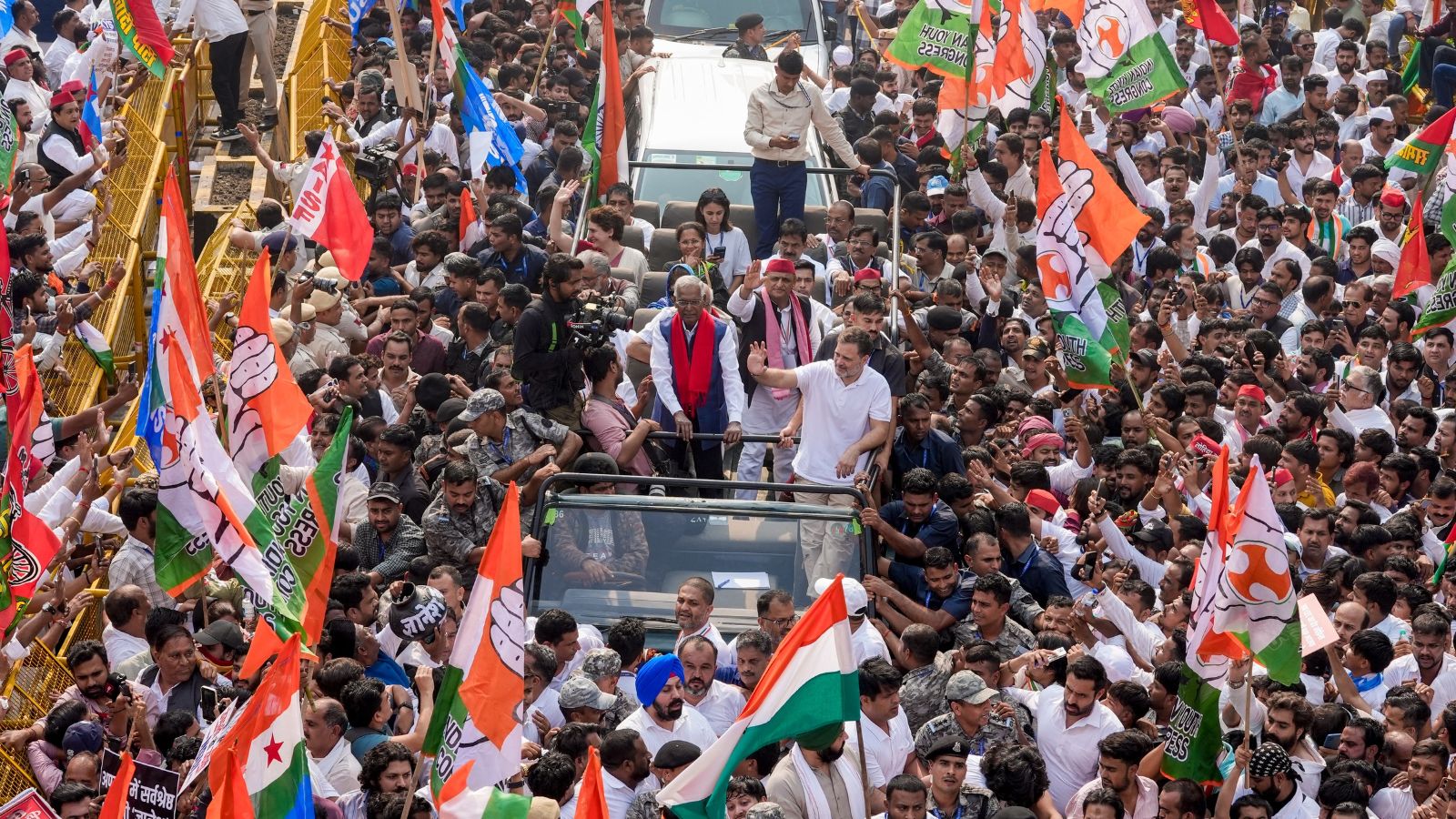


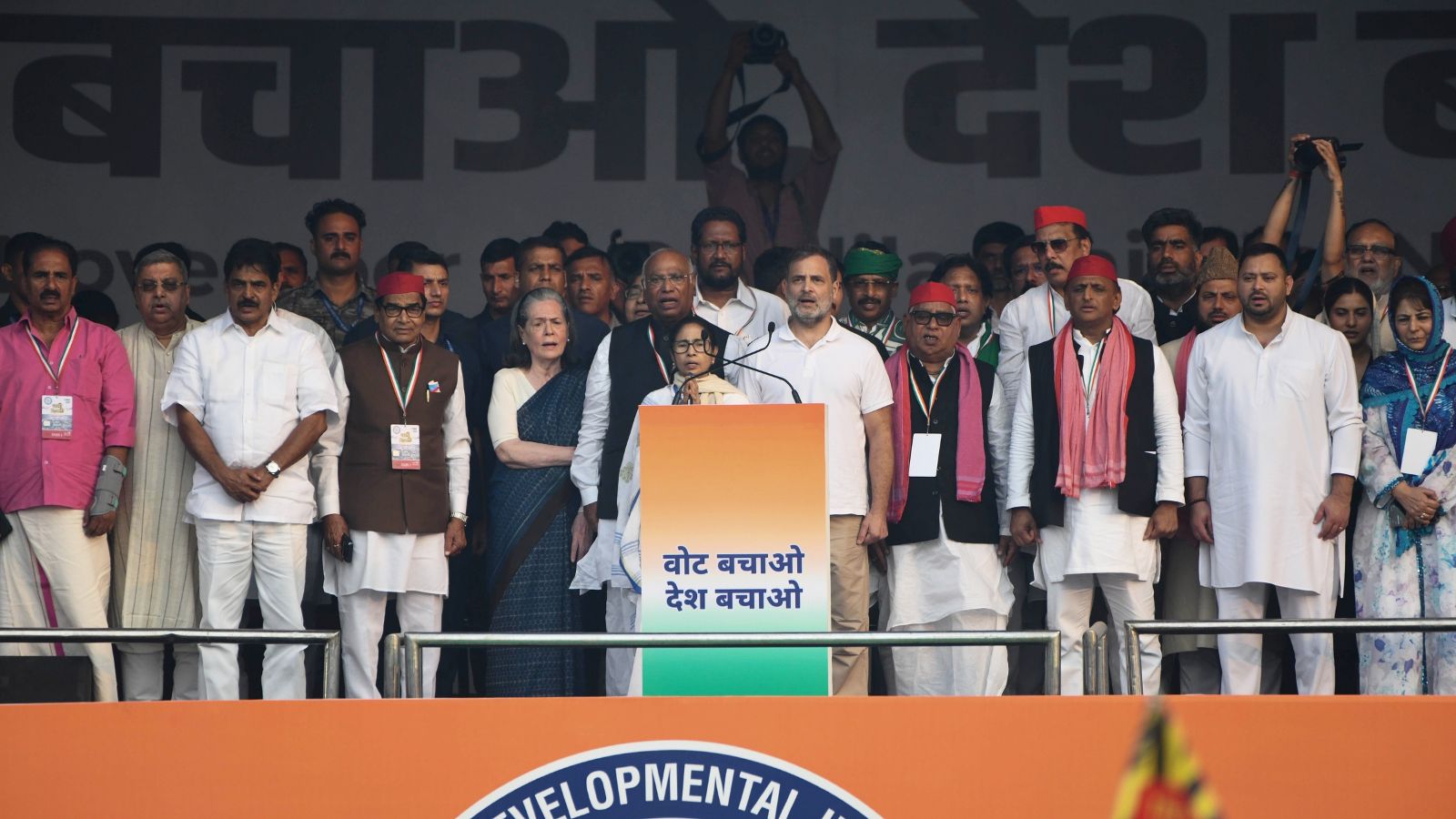
Bengaluru: When leaders of the Congress, Samajwadi Party, Trinamool Congress and Left parties shared a stage at Delhi's Ramlila Maidan on Sunday, November 1, they were united by a demand that went beyond the resignation of Chief Election Commissioner Gyanesh Kumar.
Under the slogan 'Vote Bachao, Desh Bachao', thousands gathered to protest against the Special Intensive Revision (SIR) of electoral rolls and what opposition parties allege is the Election Commission's failure to ensure free and fair elections.
Congress leader Rahul Gandhi, CPI(M) general secretary M A Baby, CPI(ML) Liberation general secretary Dipankar Bhattacharya, Samajwadi Party chief Akhilesh Yadav and other opposition leaders took turns addressing the gathering.
Their political positions may differ considerably, and some of these parties are rivals in their respective states. Yet they have found common ground in an issue that strikes at the foundation of electoral democracy: the right of every eligible citizen to vote.
For the BJP, the growing mobilisation presents a political challenge. What began as opposition to an electoral-roll revision exercise is increasingly being framed as a wider campaign over the independence of constitutional institutions and the credibility of elections.
The BJP's dilemma over Gyanesh Kumar
The demand for Kumar's resignation has placed the Narendra Modi government in an unusual political position.
The Chief Election Commissioner cannot be removed at the government's discretion. Article 324(5) of the Constitution provides that the CEC can be removed only in the same manner and on the same grounds as a Supreme Court judge. This requires a parliamentary process involving a special majority in both Houses.
The opposition had earlier submitted motions seeking Kumar's removal. However, the Lok Sabha Speaker and Rajya Sabha Chairman rejected the motions in April 2026.
His removal, therefore, is not something the government can simply order. Nor does the opposition's demand automatically translate into a legal process that can compel his exit.
This leaves the BJP facing a difficult political situation. If Kumar continues in office, opposition parties can keep the controversy alive and question the credibility of the electoral process under his leadership. A voluntary resignation, on the other hand, could be presented by the opposition as an acknowledgement that its campaign has forced accountability.
The government has rejected the allegations against the Election Commission and defended SIR as an exercise to identify duplicate and ineligible voters. The BJP has also accused the opposition of questioning democratic institutions selectively whenever it loses elections.
But the controversy has acquired another dimension following an investigation by The Indian Express, which reported that Election Commissioners Sukhbir Singh Sandhu and Vivek Joshi had raised objections on record at least 14 times over 10 months to decisions concerning voter registration, deletions, restoration of names and the management of electoral-roll data.
The Election Commission subsequently maintained that its decisions were unanimous and described the recorded objections as part of its decision-making process.
The disagreements do not establish that elections were manipulated. However, they have brought questions about the Commission's internal functioning and transparency into public debate.
For the BJP, dismissing the opposition's allegations as political propaganda does not entirely address these questions. The Commission must be able to demonstrate that the electoral-roll revision is transparent, that eligible voters are not arbitrarily excluded and that those affected have an effective mechanism to challenge deletions.
Rahul Gandhi and the attempt to build a national campaign
Rahul Gandhi has made electoral accountability one of the central themes of his political campaign against the BJP.
His repeated use of the phrase 'vote chori' has helped take the controversy beyond the technicalities of electoral-roll revision. By linking alleged irregularities to the larger question of who gets to choose India's government, Gandhi has attempted to make the issue relevant to voters across states.
Addressing the November 1 rally, Gandhi warned Prime Minister Narendra Modi and Home Minister Amit Shah that they too would face legal action over alleged electoral wrongdoing.
“After Gyanesh Kumar, we will stand against you and don't forget that for the vote chori you have done, there will be legal action against you and Narendra Modi,” he said.
Gandhi's intervention has given the campaign national visibility. His participation in street protests, including the October 6 march towards the Election Commission headquarters, has also signalled that the Congress intends to take the issue beyond Parliament.
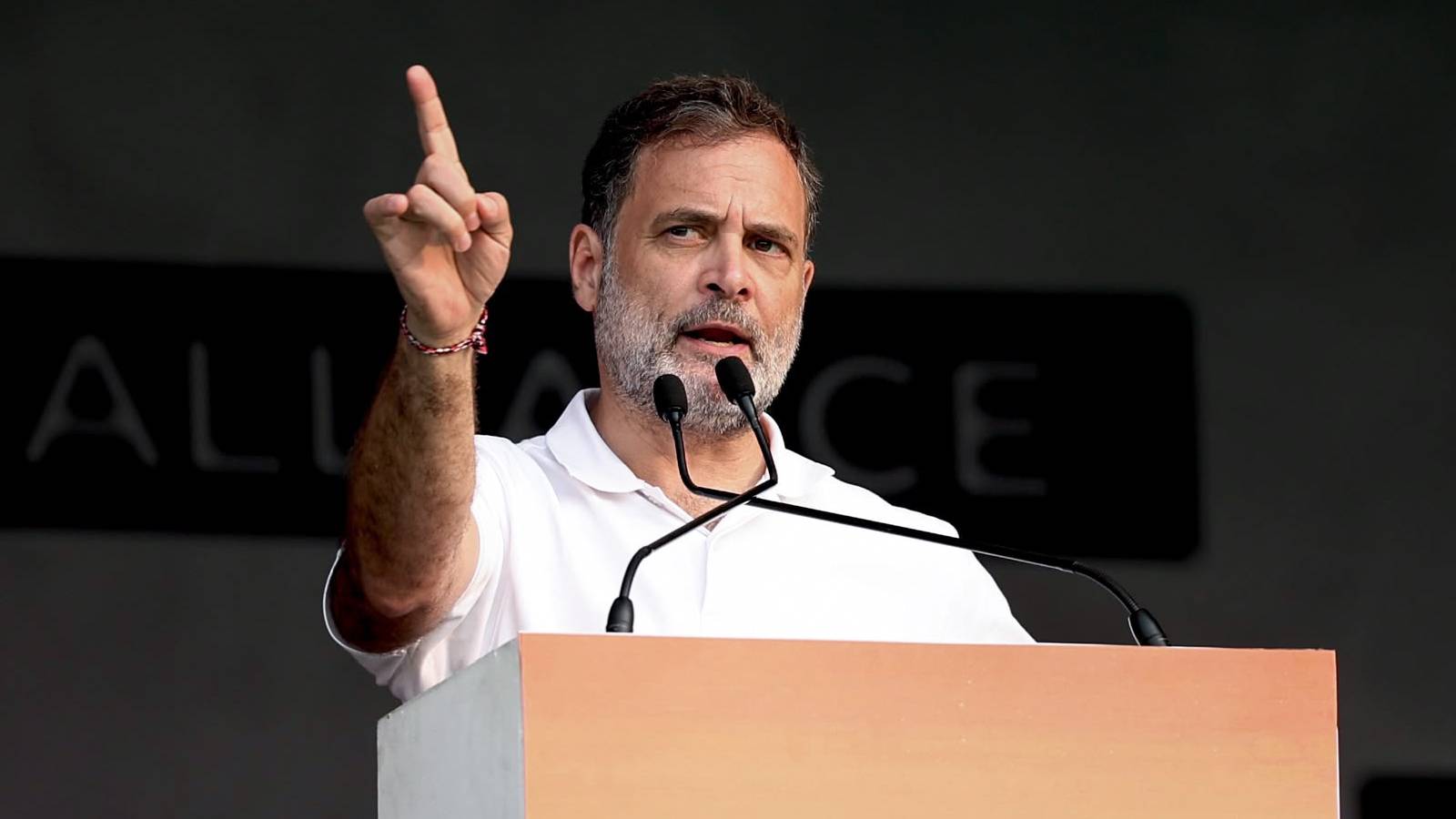
However, the campaign cannot remain centred on Gandhi alone. The INDIA bloc's strength lies in bringing together regional parties and political organisations with their own support bases. For the mobilisation to have a wider reach, the Congress will have to work with these parties as equal political partners rather than treating them as participants in a campaign led exclusively by its leadership.
The November 1 rally was significant in this respect. Despite differences over leadership, electoral strategies and state-level political interests, opposition parties returned to a common platform.
Why the Left's participation matters
The participation of Left parties is particularly relevant because they have consistently framed the controversy as a question of constitutional rights rather than merely an electoral confrontation between the BJP and the Congress.
At the Ramlila Maidan rally, CPI(ML) Liberation general secretary Dipankar Bhattacharya described SIR as a “surgical strike on democracy”.
“The whole nation has understood that SIR is a tool to snatch away people's right to vote, a surgical strike on people by the government,” he said.
Bhattacharya also demanded that the 2023 law governing the appointment of the Chief Election Commissioner and other Election Commissioners be repealed.
“Ambedkar gave the right to vote to all. We will not let it go,” he said, calling on young people to join the campaign.
CPI(M) general secretary M A Baby described the mobilisation as a “second struggle for independence” against what he called the RSS's fascist politics.
“Your fascist tactics will not work in India,” Baby said, addressing Modi, Shah and Kumar.
The Left's contribution is not limited to its presence at opposition rallies. Its political organisations, trade unions, student networks and cadre structures offer an avenue to take the campaign beyond parliamentary politics and into public spaces.
Its emphasis on universal voting rights also connects the SIR controversy to the concerns of communities that are often more vulnerable to exclusion from administrative processes.
This is important because the consequences of electoral-roll deletions are not merely political. For a person whose name is wrongly removed, the immediate consequence is the loss of an opportunity to participate in choosing the government.
The Left has also been involved in protests against Kumar outside the formal INDIA bloc mobilisation. Its participation in earlier demonstrations, including those where the Congress was not present, indicates that the campaign has a broader political base.
For the Left, the challenge is to sustain this mobilisation and ensure that the demand for electoral accountability does not become restricted to the fortunes of individual opposition parties.
A larger 'Save the Constitution' campaign
The INDIA bloc's campaign against SIR is also part of a broader political narrative that the opposition has been building since the 2024 Lok Sabha elections.
The demand for a caste census, concerns about economic inequality, allegations of crony capitalism and the protection of constitutional institutions have all featured in this narrative.
The common thread is the opposition's attempt to argue that democratic rights cannot be separated from questions of social and economic justice.
The slogan 'Vote Bachao, Desh Bachao' reflects this approach. It attempts to connect the right to vote with the larger question of whether constitutional safeguards are functioning as intended.
This also explains why regional parties have joined the campaign despite their differences with the Congress and the Left.
The challenge, however, is that the INDIA bloc is not a uniform political alliance. The Congress and the Left compete in Kerala, while the Congress and the Trinamool Congress are rivals in West Bengal. Regional parties have their own political interests, particularly when it comes to delimitation and the distribution of parliamentary representation.
An intensifying confrontation with the BJP could bring these parties together on constitutional questions, but it could also make negotiations over major legislative proposals more complicated.
The opposition will have to find a way to maintain this unity without expecting its constituents to abandon their independent political positions.