


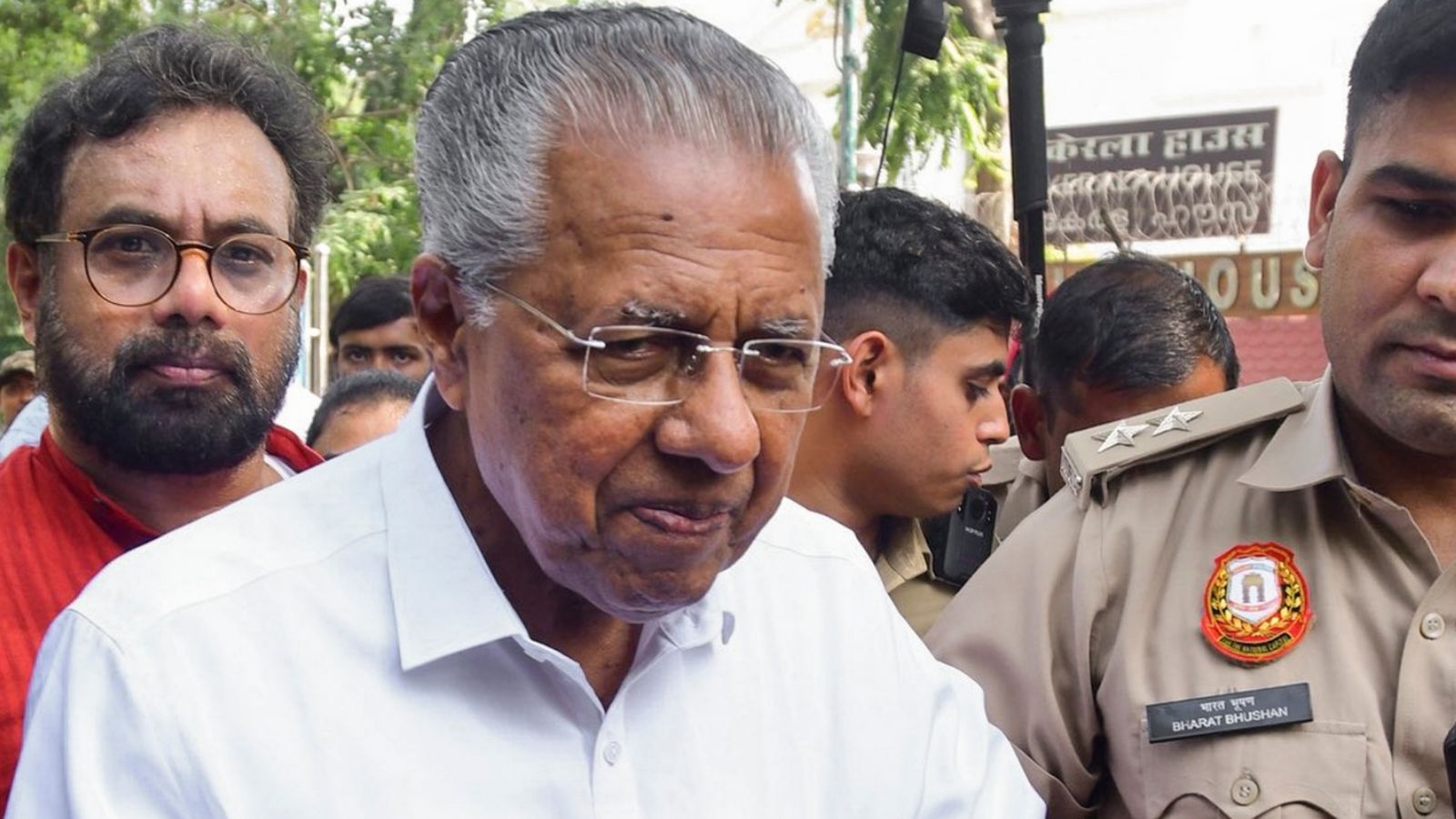


In what can be said to be a relief for former Kerala Chief Minister Pinarayi Vijayan, the Supreme Court on Wednesday, October 21, temporarily stayed the investigation into a criminal case against him, his daughter Veena T and his son-in-law PA Mohammed Riyas in connection with alleged financial transactions between Cochin Minerals and Rutile Limited (CMRL) and Veena’s now-defunct IT company, Exalogic Solutions.
The stay will remain in force for one week, giving Vijayan and the others an opportunity to challenge a Kerala High Court order directing the registration of a First Information Report (FIR) against them. The Supreme Court set aside an earlier decision by a High Court Division Bench that had refused to entertain their appeals against the FIR-registration order.
However, the Supreme Court has not quashed the FIRs or ruled on whether the allegations are true. It has allowed the criminal case to remain on record while temporarily halting the investigation and directing that the challenge be considered by the appropriate High Court bench. The immediate dispute is therefore as much about the procedure followed to initiate the investigation as it is about the allegations themselves.
The case has acquired political significance because it involves the family of Vijayan, who led the CPI(M)-headed Left Democratic Front (LDF) government in Kerala during much of the period under scrutiny. It also brings together the Enforcement Directorate (ED), the Income Tax Department, the Serious Fraud Investigation Office (SFIO) and Kerala’s state investigative machinery.
At its centre is a fundamental question: were payments made by a private company to an IT firm for legitimate business services, or were they payments without corresponding services that warrant investigation for possible financial and criminal wrongdoing?
What is the CMRL–Exalogic case?
The controversy concerns payments made by CMRL, a Kochi-based mineral-processing company, to Exalogic Solutions, an IT consultancy associated with Veena T, the daughter of Pinarayi Vijayan.
The transactions came under scrutiny after Income Tax Department searches and subsequent proceedings raised questions about payments recorded as business expenses by CMRL. Exalogic had reportedly received money under arrangements for software development, management and consultancy services. Investigators subsequently questioned whether the services described in those arrangements had actually been provided.
According to reports on the Income Tax proceedings, CMRL paid approximately Rs 1.72 crore to Exalogic during the 2017–18 and 2018–19 financial years. The Income Tax Department’s Interim Board of Settlement subsequently described the transactions as illegal payments.
The ED and other investigating agencies later examined a broader set of financial transactions involving CMRL, Exalogic and related entities. The figures cited in different proceedings vary according to the transactions, entities and periods being examined. The Kerala High Court’s October 2026 proceedings, for instance, referred to allegations involving payments of more than Rs 2.78 crore, while other reports have cited additional payments involving a CMRL group company.
The central allegation is that money was transferred to Exalogic despite an alleged absence of corresponding services, raising questions about whether the transactions were genuine commercial payments or concealed benefits. Investigators have also examined whether the transactions could be connected to a broader arrangement involving payments to individuals and entities for purposes unrelated to CMRL’s business.
Veena and Exalogic have maintained that the payments arose from legitimate business arrangements. No final judicial finding has established that the payments constituted bribery by Pinarayi Vijayan or that he personally received any of the alleged proceeds.
How did the controversy begin?
The case has its origins in Income Tax Department action against CMRL and the financial records examined during the subsequent settlement proceedings.
Searches conducted in 2019 uncovered records relating to payments allegedly made by the company to various individuals and entities outside its regular business transactions. CMRL and its managing director, Sasidharan Kartha, subsequently approached the Income Tax Department’s Interim Board of Settlement.
The records examined during these proceedings brought payments to Exalogic into focus. The company had received money under consultancy arrangements, but the tax authorities questioned whether the services corresponding to those payments had been delivered.
The matter became more politically sensitive because Exalogic was associated with Veena, whose father was Kerala’s Chief Minister during the period under examination.
The Income Tax proceedings were followed by investigations by other agencies. The ED examined the transactions from the perspective of possible money laundering, while the SFIO investigated alleged corporate and financial irregularities involving CMRL and Exalogic.
The agencies’ inquiries did not begin with the October 2026 FIR. Rather, that FIR emerged from a later legal dispute over information the ED had shared with Kerala’s state authorities and whether the state police were required to register a criminal case immediately.
Why did the Kerala High Court order an FIR?
The immediate legal battle began when K M Shajahan, a complainant who approached the court seeking action on the ED’s findings, challenged the state government’s decision to conduct a preliminary inquiry instead of registering an FIR.
On October 9, 2026, Justice A Badharudeen of the Kerala High Court allowed Shajahan’s petition and directed the state Vigilance and Anti-Corruption Bureau (VACB) to register an FIR under the Prevention of Corruption Act.
The single judge held that the material forwarded by the ED disclosed information about cognisable offences and that the state could not substitute a preliminary inquiry for an FIR in those circumstances. The court also set aside the decision to conduct the preliminary inquiry through the SIT.
The material referred to in the proceedings included financial records, statements and other documents relating to the transactions under scrutiny. The court’s order did not amount to a finding that the accused were guilty; it directed the registration of a case so that the allegations could be investigated.
The order marked a significant shift in the case. Until then, the state had chosen to examine the information through a preliminary inquiry. Following the High Court’s intervention, the state was directed to begin a formal criminal investigation.
The VACB subsequently registered two FIRs. Pinarayi Vijayan was named as the first accused in one case, while Riyas was the first accused in the other. Veena was named as the second accused in both. The cases concerned alleged corruption and conspiracy in connection with the financial dealings involving CMRL, Exalogic and an associated company.
Why did Pinarayi Vijayan approach the Supreme Court?
Vijayan, Veena and Riyas challenged the single judge’s order. One of their central objections was procedural: they argued that the order directing the registration of an FIR had been passed without hearing them and that the court should not have intervened in the manner it did.
They also questioned Shajahan’s standing to challenge the state’s decision, particularly because the police had already constituted an SIT to conduct a preliminary inquiry into the ED’s communication.
The Kerala High Court Division Bench declined to entertain their appeals. It held, in effect, that the accused could challenge the FIR through the appropriate legal process rather than appeal an order passed in proceedings to which they had not been parties. The Division Bench also observed that a person accused of an offence does not ordinarily have a right to be heard before an FIR is registered.
The accused then moved the Supreme Court, arguing that the High Court’s approach left them without an effective opportunity to challenge the order that had set the investigation in motion.
On October 21, a Bench of Justices Joymalya Bagchi and V Mohana set aside the Division Bench’s decision and permitted them to pursue their appeals before the High Court.
The Supreme Court questioned the haste with which the FIR had been ordered, particularly since the state had already constituted an SIT to conduct a preliminary inquiry. It also examined the legal basis on which the High Court had intervened before the accused were heard.
The Court did not, however, accept the request to quash the FIR outright. It allowed the FIRs to remain in place and temporarily stayed further investigation for one week, giving the petitioners time to seek relief before the High Court Division Bench.
The Supreme Court expressly limited its observations to the procedural issue before it and said they should not be treated as an opinion on the merits of the case.
What did the Supreme Court say about the ED?
Another important aspect of the October 21 proceedings was the Supreme Court’s caution to the ED against exceeding its statutory powers or interfering with the jurisdiction of other investigating agencies.
The Court questioned the use of the ED’s communication as the basis for a court-directed FIR and emphasised that the agency must operate within the limits of the law governing its powers. It indicated that the ED could pursue its own proceedings under the PMLA, but could not use those powers to intrude into the statutory domain of another agency.
The distinction matters because the ED and the VACB are investigating different legal aspects of the same underlying transactions. The ED’s money-laundering inquiry operates under central legislation, while the VACB’s investigation concerns alleged corruption offences under the Prevention of Corruption Act.
The Supreme Court’s observations should not be read as a blanket prohibition on the ED sharing information with state police. Section 66(2) expressly provides for such information-sharing. The dispute concerns what legal consequences should follow from that communication, the extent of the receiving agency’s discretion and the manner in which a court can direct the registration of an FIR.
Nor did the Supreme Court declare that the ED’s allegations were false or that its investigation was unlawful in its entirety. Its immediate intervention concerned the FIR and the procedure through which the state investigation had been initiated.
Does the Supreme Court stay mean the case has been closed?
No. The FIRs remain in place, and the Supreme Court has not exonerated Vijayan, Veena or Riyas.
The one-week stay is an interim measure intended to allow the accused to pursue their challenge before the Kerala High Court. The High Court Division Bench will have to consider their appeals and decide what relief, if any, is warranted under the law.
The Supreme Court’s order also does not, by itself, establish that the separate ED proceedings under the PMLA have been stayed. Those proceedings must be understood in the context of the orders that govern them.
The legal position is therefore narrower than either a claim that the accused have been cleared or a claim that the Supreme Court has endorsed the allegations. The Court has temporarily halted the state investigation while the procedural challenge is considered.
Meanwhile, the CPI(M) has described central agency action against its leaders as politically motivated, while Veena and Exalogic have denied wrongdoing and maintained that the transactions were legitimate business dealings.