

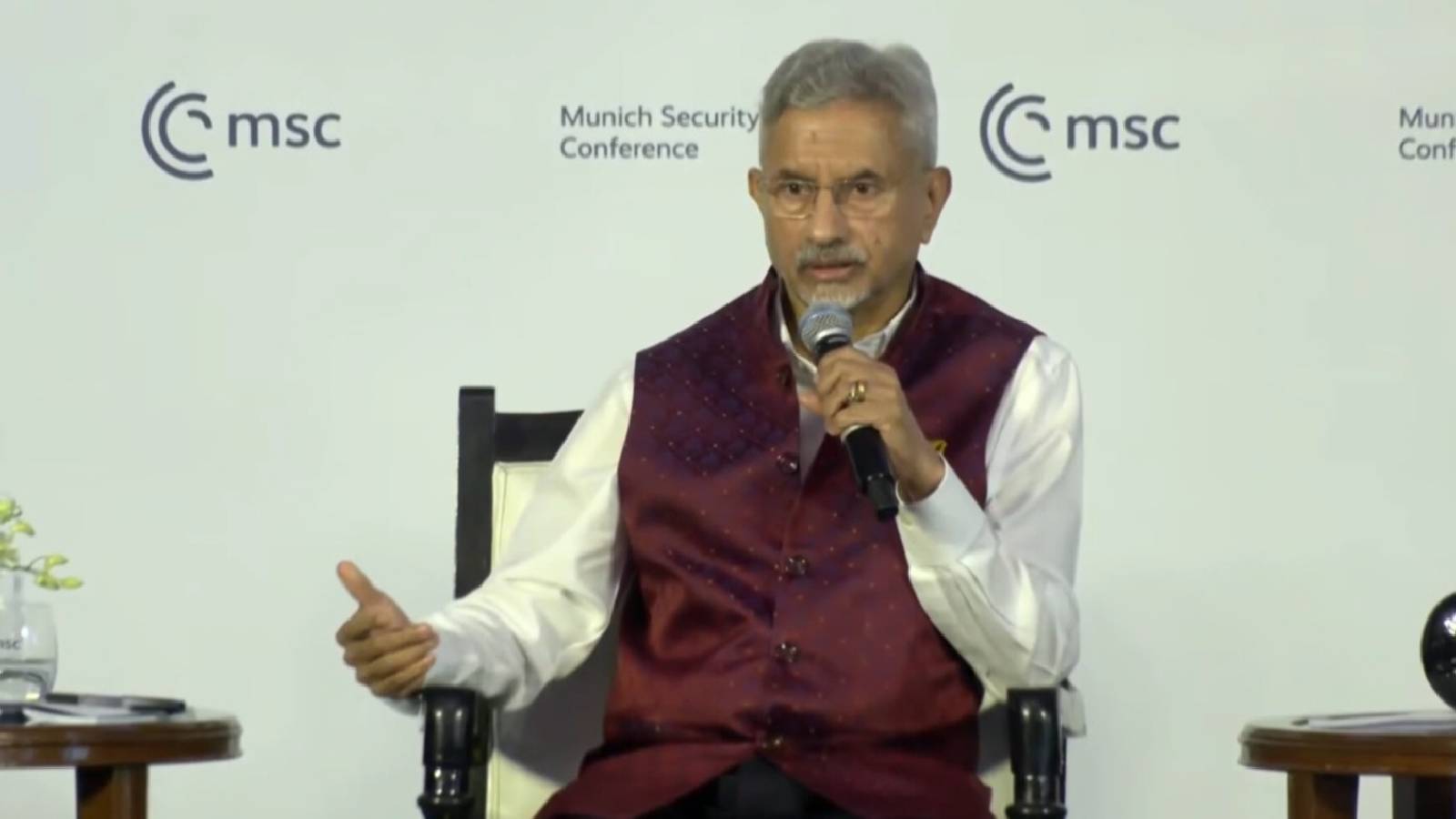


New Delhi: The United States has "deliberately become a lonelier power," stated External Affairs Minister (EAM) S Jaishankar on Sunday in his address at the opening session of the Munich Leaders Meeting 2026 here.
Jaishankar referred to “radical repositioning of the United States” due to which it has in a way “deliberately become a lonelier power” and said the sharp competition in the global landscape is not limited to US and China but has has led to “weaponization of any leverage that any country has”.
"No one in the room would disagree with the fact that the landscape today is primarily marked by a radical repositioning of the United States. A repositioning which is a posture of choice and, in a way, it has deliberately become a lonelier power. The second feature of the landscape is, of course, the rise of China. China, which sees itself as a unique country that is in a way both its self-perception, in many ways, also the reality. And we are looking at very sharp competition,” he said.
“That competition today, not limited to these two countries, has led to a weaponization of any leverage that any country has. And that competition coexists with the complexity of interdependence," he added.
Jaishankar praises Russia
In his opening address, Jaishankar also praised Russia, saying that the country stood by India when much of the world backed military regime next to the nation.
"At a time when much of the world preferred backing the military regime next to us, Russia was a country with which our relations were very good," the EAM said.
Emerging and middle powers united by a growing self-awareness of their interest
Jaishankar also stressed that emerging and middle powers are united by a growing self-awareness of theirinterests.
“Amongst the emerging and middle powers, to the extent that they don't have direct clashes of interest, they have an interest in strengthening their interstate cooperation, but it is also natural that they would have cooperation with the US and China. Let's look at some examples of this kind of cooperation... One is the Quad... In the field of connectivity, we have the India-Middle East-Europe Economic Corridor, the International North–South Transport Corridor, and the polar route, the Northern Sea Route,” he said.
Jaishankar said BRICS is an example of various parties who feel that their collective voice is much stronger than the individual ones.’
“The International Solar Alliance or the Coalition for Disaster Resilient Infrastructure, both of which India initiated and which have been very successful... So you have this situation where a number of countries, not necessarily the leading countries... they come together where their interests require them to do so: they find working arrangements, develop an agenda, develop organizations, develop habits of cooperation, and this is today's evolving global order," he said.
Jaishankar also referred to accelerated emergence of multipolarity. “...The idea that countries will have relationships with players which may not always be easy to harmonize, but nevertheless are a reality, is a compulsion for countries. It's a sort of strategy of advancing by hedging. One will then have to look at what the consequences of this are for multilateralism, which is already under visible pressure because the main multilateral body, the United Nations, is very visibly gridlocked. Finally, the fact that a resulting outcome of this would be the kind of small groups," he said.
(With inputs from ANI & PTI)