

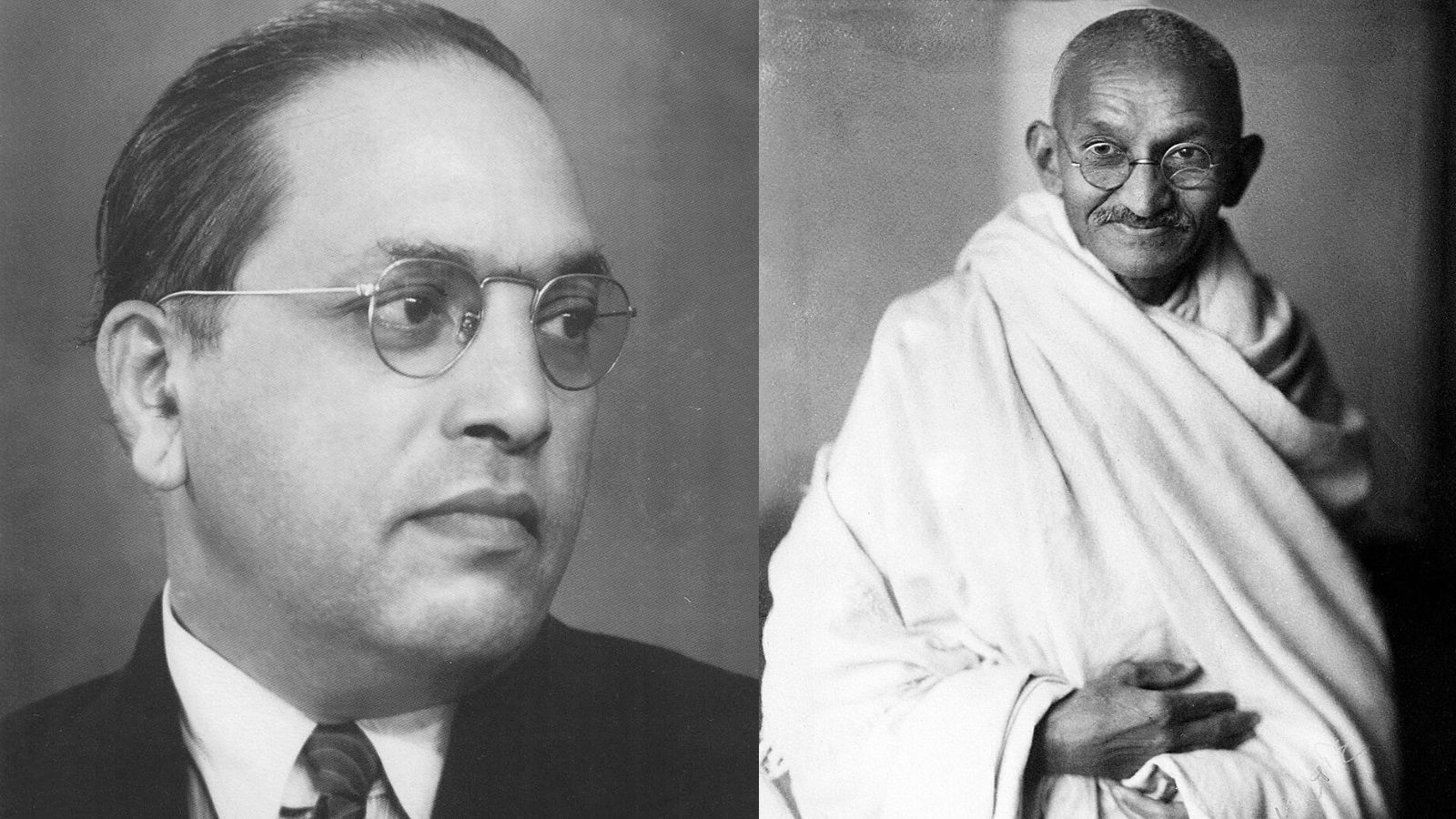


New Delhi: Nearly a century before the latest debate began on who can or cannot be on voter lists, Mahatma Gandhi had made a strong pitch for voting rights for everyone. About one and a half decades later, when the Constitution for an independent India was being framed, its architect BR Ambedkar and some other leaders proposed making voting a fundamental right, but the idea was rejected by an advisory committee set up by the Constituent Assembly in 1947.
The issue was still debated multiple times in the Constituent Assembly over the next couple of years.
Since then, the issue has remained in focus now and then, but this focus has sharpened a lot more now due to the Election Commission's Special Intensive Review (SIR) of voter lists already pushing crores of names out of the rolls, and many more are still facing the risk of exclusion. Experts and political leaders are again pitching for making voting a fundamental right, or at least ensuring that this right is not snatched from genuine adult citizens of the country.
Writing in his weekly newspaper, Young India, on October 8, 1931, Mahatma Gandhi, whose 157th birth anniversary will be celebrated on Friday, said he cannot bear the idea that a man who has got wealth should have the vote, but that a man who has got character but no wealth or literacy should have no vote. "A man who works honestly by the sweat of his brow day in and day out should not have the vote for the crime of being a poor man; it is an unbearable thing," he wrote.
"I would far rather forego the right of voting myself than that this untouchable brother should not have the vote," he said.
Talking about voters' lists, Gandhi said he was not enamoured of the doctrine of literacy, that a voter must at least have a knowledge of the 'three Rs '. The 'three Rs' refer to basic skills of reading, writing and arithmetic, which have been humorously pronounced as 'reading, riting and rithmetic' as a pun to drive home the message of literacy. Gandhi wrote, "I want for my people a knowledge of the three Rs, but I also know that if I have to wait until they have got a knowledge of the three Rs, before they can be qualified for voting, I shall have to wait until the Greek Kalends, and I am not prepared to wait all that time."
Greek Kalends refer to a day that never comes
The first day of each month in the ancient Roman calendar was called 'Calends', but the Greek calendar did not use the calends system.
Many experts over the years have talked about the difficulties that may arise from making voting a fundamental right. Most of these problems are related to India's huge population.
Gandhi talked about that too
"I know millions of these men are quite capable of voting, but if we are going to give them all the vote it will become very difficult, if not absolutely impossible, to bring them all on the voters' list and have manageable constituencies," he said.
He proposed a solution too. "We can have this alternative: that he who wants to vote can have the vote... I think a scheme of that character would keep the voters' list in a manageable compass," Gandhi wrote.
KF Wilfred, former senior principal secretary at the Election Commission of India, said it was proposed initially in the Constituent Assembly to make voting a fundamental right, but it was excluded due to reasons like the size of India's electorate.
"In principle, we cannot say it should not be a right because it is an important right. But then, considering the size and reasons like one not being able to vote, or someone else voting in someone's name, the entire election process can be impacted," he said. The issue of making voting a fundamental right has also reached courts multiple times, and it has been said that it may not be a fundamental right, but it remains fundamental to India's democracy.
The law describes voting as a statutory right
PDT Achary, former Secretary General of Lok Sabha and a distinguished constitutional expert, said voting may not be a fundamental right right now, but it is a constitutional right.
"The Supreme Court, in several cases, has clarified that it is not a fundamental right, but it is a right which is given under a statute," he said. On steps that can be taken to ensure that all eligible citizens can vote, he said it is a very difficult question in the present situation because things have become so complicated with the introduction of SIR.
He said SIR does not find a place in the law, but there is a provision for intensive revision of rolls. He said special revision of voter lists can be undertaken in places where the Election Commission feels there is an unusually large influx of people in a particular constituency, and such revisions have taken place in border areas in the past.
But such special revisions have been confined to those constituencies where such a change has been noticed, he said. He said people have started talking about their voting rights only after a large-scale deletion of names from the voter lists.
"Under Article 326, every citizen of India, unless he is disqualified under some law, is entitled to be registered; that is what the Constitution says. It is not the Election Commission's charity or anything. They are entitled under the Constitution. Constitution gives you this entitlement. That is the thing," he said.
If the Constitution entitles you to be registered as a voter, how can the Election Commission remove your name or put you under some dubious categories, for example, logical discrepancies, Achary wondered.
When the Constitution of India was being framed, an advisory committee set up by the Constituent Assembly debated in April 1947 whether the right to vote could be a fundamental right. The committee was chaired by Sardar Patel and Ambedkar, along with some other leaders, who strongly spoke in favour of voting as a fundamental right, but the proposal could not pass muster, and it was decided that universal adult suffrage would be good enough.
Universal adult suffrage refers to every eligible adult having the right to vote without discrimination based on race, gender, religion, wealth, or social status. Referring to this debate in 1947, Congress leader and Rajya Sabha MP Jairam Ramesh said there has been a continuing debate over the past seven decades over whether the Right to Vote is a statutory right or an explicit fundamental right.
"The Supreme Court has itself recognised that voters have a Constitutional and fundamental right to know the criminal antecedents of candidates, their financial interests, and sources of political funding. It has protected ballot secrecy and recognised the right to reject all candidates through NOTA. It is, therefore, all the more anomalous that the right to vote remains only a statutory right," he said.
"All surrounding rights have been declared fundamental, but the core without which the former cannot exist remains statutory," the Congress leader said. Accusing the government and the Election Commission of indulging in a blatant partisan manner, he said it is time to elevate the Right to Vote as a fundamental right that would offer it the highest level of judicial review and protection.
"It would be a powerful step in putting in place safeguards against voter suppression or arbitrary disqualifications that have taken place in different states in astronomical numbers under the SIR process. It would also mean greater Supreme Court vigilance over the functioning of the Election Commission," he said.
The debate is likely to continue further as several issues related to it are being heard in courts, while opposition parties have announced plans to take to the streets over the SIR.