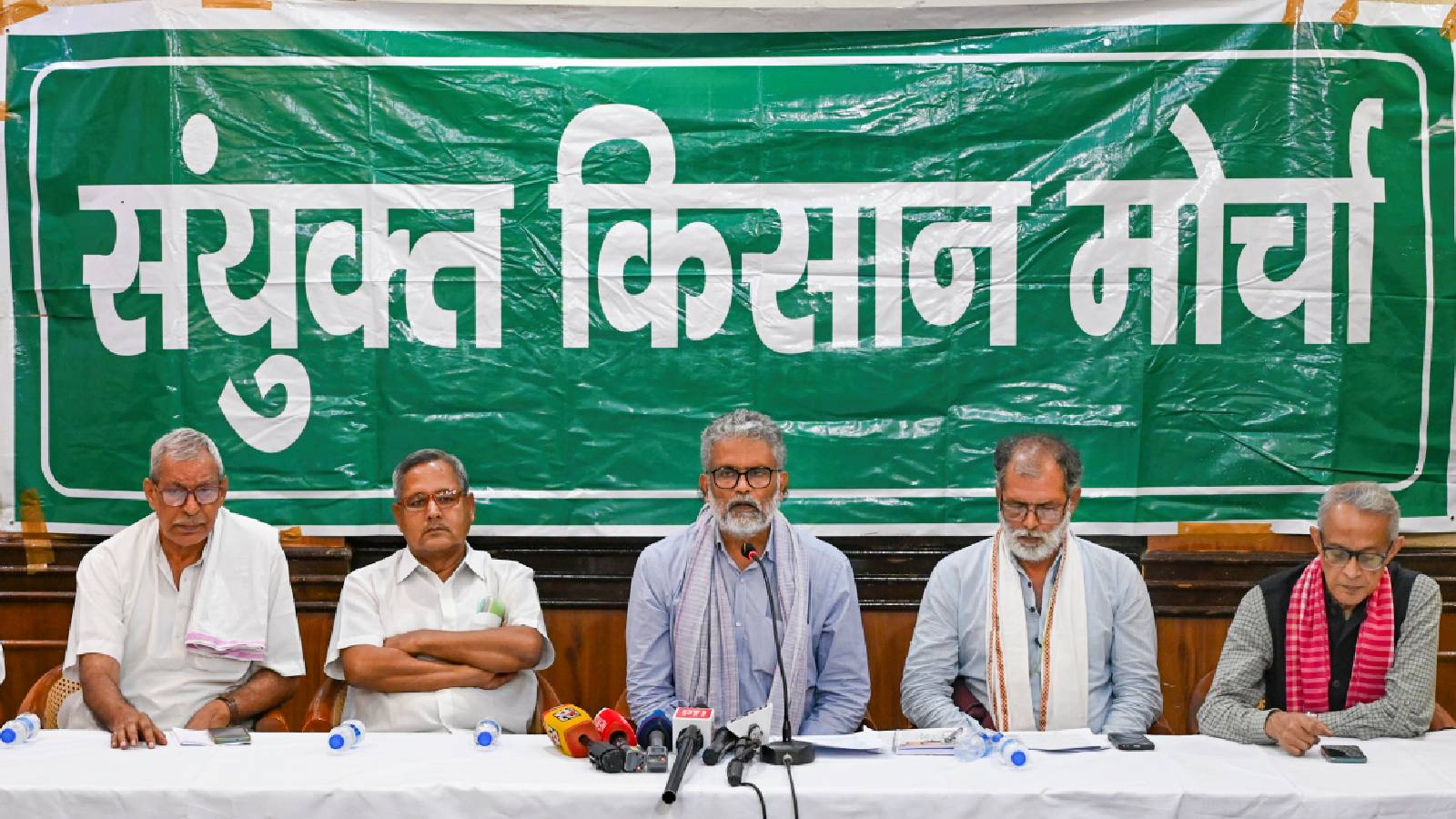


New Delhi: The Samyukt Kisan Morcha (SKM) on Monday announced a phased nationwide agitation beginning August 10 and culminating in farmers' marches and multi-day mass actions on November 26 in Delhi and around 100 places across the country to press for its seven key demands.
SKM leaders said the agitation will begin with ‘Jail Bharo’, ‘Rail Roko’ and ‘Road Roko’ protests at over 1,000 locations, adding that they would continue until their demands are met.
Addressing a press conference here, SKM leaders said the programme was finalised at its All India Convention held in Delhi on July 28, attended by around 1,200 delegates, and the National Convention of Workers and Farmers on July 29, drawing nearly 5,000 leaders of trade unions and farmers' organisations.
SKM National Coordination Committee member Avik Saha said the farmers' body had spent the past five years trying to persuade the government to honour the written assurances given after the repeal of the three farm laws, but without success.
"Five years have passed. It is not that we did not try. We also went to the Leader of the Opposition (Rahul Gandhi), but nothing happened. There was not even a discussion in Parliament. The country has now seen that when required, Parliament comes to the streets. We will speak to them on the streets," Saha said.
He said more than 1,000 centres had been identified for the August 10 protests, while SKM delegations would meet Members of Parliament, MLAs, chief ministers and leaders of opposition on August 17 to present a charter of demands.
The agitation will thereafter be intensified through state conventions, mass padyatras, vehicle jathas, tractor marches, public meetings, mahapanchayats and state rallies before the launch of kisan marches and multi-day mass actions from November 26, he said.
Saha said the protests beginning November 26 would be held in the national capital of Delhi and around 100 locations across the country, adding that it would not be called off until all seven principal demands were accepted.
The demands include a law guaranteeing MSP based on the National Farmers' Commission's formula with assured procurement for all crops; a comprehensive farm loan waiver; repeal of the four labour codes; restoration of the MGNREGA with 200 days of work and a daily wage of ₹700; withdrawal of the Electricity Privatisation Bill, Seed Bill and amendments to the National Food Security Act; protection of land rights and opposition to the proposed India-US Free Trade Agreement.
The SKM alleged that farmers suffered massive losses due to India government's failure to implement the M S Swaminathan Commission's recommendation of fixing MSP at C2+50 per cent.
It claimed that while the government continued with the A2+FL+50 per cent formula, farmers growing 20 major crops lost an estimated ₹27 lakh crore between 2016 and 2025.
For the 2026-27 kharif season, it said the MSP for paddy had been fixed at ₹2,441 per quintal against ₹3,243 per quintal under the C2+50 formula, leaving a gap of ₹802 per quintal.
Claiming that nearly 90 per cent of paddy was sold below the MSP, the SKM estimated the total loss to paddy farmers at about ₹ 2.89 lakh crore this year, or ₹24,464 per acre.
Referring to these estimates, AIKS leader Krishna Prasad said the annual PM-Kisan Samman Nidhi assistance of ₹6,000 was insignificant compared to the losses suffered by cultivators.
“PM-Kisan Samman Nidhi is only₹6,000. We are asking the RSS, which has influence over many BJP leaders, why the assurance on MSP has not been implemented. Your 'Pradhan Sevak' gave the assurance on MSP,” he said.
“You asked people to bring you to power. Twelve years have passed. Why has the MSP still not been implemented?" he added.
Prasad alleged that the government was diverting attention from the MSP issue and said farmers, including moong growers, were joining the agitation over remunerative prices.
The SKM also reiterated its opposition to the proposed India-US Free Trade Agreement, alleging it would hurt farmers, workers and small and medium enterprises by increasing imports of cheaper agricultural products and undermining domestic agriculture.