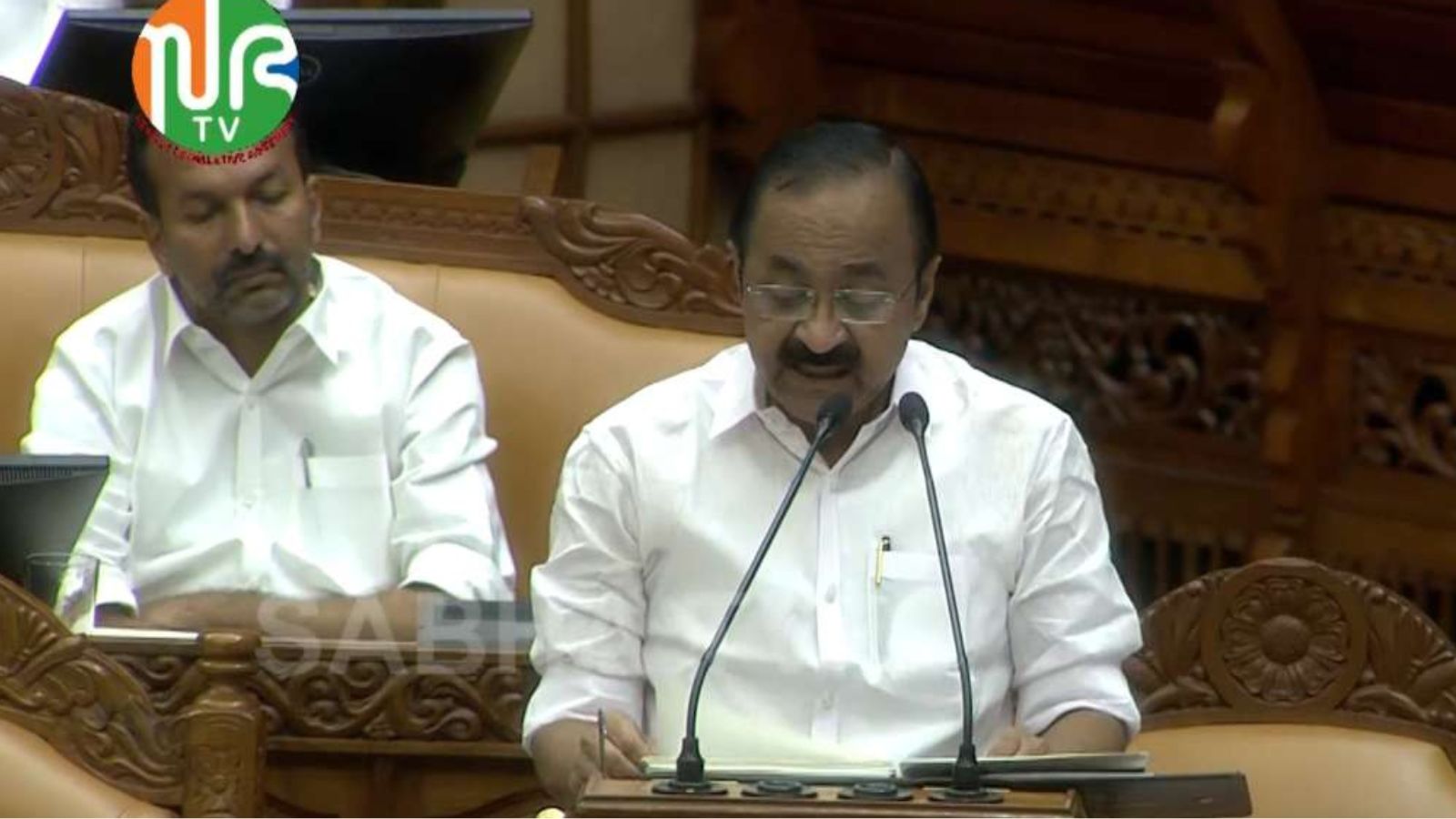


Thiruvananthapuram: Kerala Chief Minister V D Satheesan, who also holds the Finance portfolio, on Friday presented the revised Budget for 2026–27 in the Assembly, pledging to build a "New Kerala" with inclusive growth and sustainable infrastructure development.
Citing severe fiscal stress, hidden liabilities, lower remittances and inflation as key challenges before the government, the CM unveiled Mission Samudra to build a port-led economy, elevate the state as a global maritime and economic hub.
The government is committed to stimulating the economy through broad-based development strategies, attracting large-scale investments across various sectors, mobilizing financial resources for the public exchequer, and ensuring the equitable distribution of wealth, the CM said.
"To achieve these objectives, I will now outline the government’s flagship initiatives," he said.
By integrating Kerala’s 600-kilometre coastline, two international ports, one container transshipment terminal, 17 non-major ports, and numerous other water-based resources, the government aims to establish Kerala as a major presence on the global maritime map within the next five years.
The vision is to transform Kerala into a port-led economy by developing a maritime ecosystem that connects roads, seaports, railways, inland waterways, industrial zones, and greenfield cities.
He said that ₹400 crore will be allocated to the Mission Samudra project.
Satheesan said that the government was committed to stimulating the economy through broad-based development strategies and announced ₹200 crore for turning the state into an aviation and logistic hub centered around its four airports.
Besides that, the government will also launch a Data-based Invest Kerala cell to attract investment by addressing key business bottlenecks, the CM said in his Budget speech.
Reforms to land laws to boost industrial infra in state
The revised Kerala Budget also notes that reforms will be made in the land laws to give a boost to the industrial infrastructure aspirations of the state by harnessing its land resources.
Satheesan said that acute scarcity of land, limitations in its mobilisation and a lack of legal clarity constitute the most formidable barriers to Kerala's industrial infrastructure aspirations.
He said that while investors were actively seeking land for projects capable of transforming the economy, vast tracts of land held by government departments and public sector undertakings were lying around "unutilised or entangled in red tape".
"To systematically address this structural challenge, the government will formulate a comprehensive land management policy," the CM, who also holds the Finance portfolio, said.
As part of the policy, a robust land management framework will be established, supported by necessary legislation, to create a land bank utilising surplus and unused land parcels belonging to various departments and public sector undertakings, he said.
Besides that, land laws that were relevant in the past will be rigorously reviewed, and outdated statutes will be amended under the Land Reforms 2.0, he added.
Additionally, the procedure for converting land for commercial enterprises will be expedited and a land pooling framework will be introduced for large-scale projects, the CM said.
He said that government agencies like Kerala Industrial Infrastructure Development Corporation (KINFRA) and Infrastructure Kerala Limited (INKEL) will be empowered to handle land acquisition processes and subsequent activities in a timely, transparent, and professional manner.
"This policy will be instrumental in harnessing our land resources for the prosperity of Kerala's economic future and its people," he said.
Boost for sports, culture with football stadium, film city projects
The revised Kerala Budget gave a major push to the sports and cultural sectors, announcing projects, including an international-standard football stadium in Malabar, a film city in Kochi and a cultural park in Kozhikode.
In a move likely to enthuse football fans, especially in north Kerala, Satheesan announced the construction of a world-class football stadium in the Malabar region and allocated ₹50 crore for the project.
Referring to the state's passion for football, he said a world-class stadium was essential to systematically identify and train football talent and host prestigious international matches.
"Recognising the immense passion and profound love for the game among football fans in Kerala, an international standard football stadium equipped with ultra-modern facilities will be constructed in the Malabar region. An amount of ₹50 crore is allocated for this project," he said.
In the first budget of the UDF government after coming to power, Satheesan also announced 'Vision 2036', an initiative aimed at nurturing athletes for the 2036 Olympic Games.
Under the programme, children with exceptional sporting talent will be identified and provided intensive training to enable participation in national, international and Olympic competitions, he said.
The budget also proposed steps to construct an international stadium at Chelad near Kothamangalam in Ernakulam district.
The cultural sector received a significant boost with announcements, including the J C Daniel International Film City-Chitranagaram in Kochi, M T Vasudevan Nair Cultural Park in Kozhikode and a music academy in memory of renowned ghazal singer Umbayi.
The film city project, for which ₹100 crore has been earmarked, is aimed at strengthening the Malayalam film industry.
"Granting formal industry status to cinema, creating a permanent venue for the international film festival, forming robust anti-piracy cells and cultivating an environment to attract premier national and international film productions are targeted through this project," Satheesan said.
The government also announced the establishment of a cultural park in Kozhikode in memory of noted litterateur M T Vasudevan Nair, allocating ₹50 crore for the initiative.
The park will feature facilities for traditional art forms, including Kathakali, Koothu, Thullal, Theyyam, Oppana, Mappilappattu, Margamkali, Ayanippattu and various tribal art forms.
Satheesan said that the park will also have spaces for screening short films and documentaries by Gen-Z creators, contemporary dance and music performances, cinema theatres, a library, an art exhibition hall, an art gallery, a history museum, a literature-language museum, a voice museum archiving writers and other eminent personalities, dedicated zones for children and senior citizens, recreational spaces, food courts, bookshops, art material shops, tourist guest houses and dormitories.
"A dedicated Cultural-Tourism Trust will be formed for the professional management of this cultural park," the chief minister said.
Among other allocations, ₹10 crore was earmarked for renovation of the historic Thekkinkadu Maidan in Thrissur district.
An amount of ₹1 crore was allocated for establishing the Aranmula Kannadi Exclusive Exhibition Centre and Training Centre.
To preserve the memory of Saint Chavara, ₹1 crore was allocated for continuation of construction works relating to the 175-year-old room, monastery building and historical and cultural museum at the Koonammavu.
The annual grant provided to the 52 Palliyodams, the main organisers of the Aranmula Boat Race, was increased from ₹10,000 to ₹15,000.
The government also announced the organisation of the Malabar-Thindis Cultural Biennale centred at Ponnani.
An amount of ₹1 crore was provided as grant to establish a cultural centre and museum in memory of artist Namboothiri with the assistance of the Namboothiri Trust.
Satheesan also announced that ₹1 crore has been allocated for the construction of a memorial to the late actor Salim Kumar in Ernakulam district.
A sum of ₹1 crore will be provided as initial expenses to establish a music academy in memory of renowned ghazal singer Umbayi.
The budget also earmarked ₹1 crore for setting up a statue and cultural centre dedicated to Sree Narayana Guru in Delhi.
As part of the 150th birth anniversary celebrations of Mahakavi Ulloor S Parameswara Iyer, a special financial assistance of ₹25 lakh was announced for the Ulloor Memorial Library and Research Institute, Satheesan said.
Further, ₹1 crore was allocated to the R Shankar Foundation of Kerala for the construction of a memorial building for former chief minister R Sankar at Pattom.
Tax relief measures
Satheesan also announced a series of tax relief measures, amnesty schemes and revisions to vehicle taxes, saying the steps are aimed at easing the burden on taxpayers, supporting businesses and improving revenue mobilisation.
The revised Budget estimates for 2026-27 project revenue receipts of ₹1,69,646.37 crore against revenue expenditure of ₹2,05,001.67 crore, resulting in a revenue deficit of ₹35,355.30 crore.
The Budget estimates capital expenditure (Net) at ₹19,651.41 crore, public debt (Net) at ₹52,364.13 crore, and an overall deficit of ₹41.23 crore. The government has also announced additional expenditure of ₹1,080.95 crore, taking the cumulative deficit at the end of the year to ₹1,504.63 crore.
One of the key tax relief announcements was the Flood Cess Arrears Settlement Scheme, 2026.
The chief minister, noted that although the one per cent Flood Cess levied on GST for Business-to-Customer (B2C) supplies between August 1, 2019 and July 31, 2021 had ended, substantial arrears remained unpaid.
To help businesses clear these dues, the government announced that taxpayers who pay the entire outstanding principal amount of Flood Cess will receive a complete waiver of interest and penalty.
The last date to settle arrears under the scheme is March 31, 2027.
The government also unveiled a Small Arrear Waiver Scheme, 2026 for pending dues under pre-GST tax laws.
Under the proposal, arrears involving tax amounts of more than ₹50,000 but not exceeding ₹2 lakh relating to assessment orders up to the 2017-18 financial year will be fully waived along with the related interest and penalty.
However, the concession will not apply to arrears linked to the sale of liquor under the Kerala General Sales Tax Act, 1963.
In the liquor sector, the Budget proposed fresh sales tax rates for low-strength alcoholic beverages under the Kerala General Sales Tax Act.
Products with 0.5 per cent to 10 per cent alcohol by volume (v/v) will attract 120 per cent sales tax, while those with more than 10 per cent and up to 20 per cent alcohol by volume will be taxed at 175 per cent.
The Budget also announced changes in motor vehicle taxation to support public transport and promote electric mobility.
Quarterly tax on All India Tourist Permit (AITP) buses has been sharply reduced, with the rate per seat cut from ₹2,000 to ₹900 and the rate per sleeper reduced from ₹3,000 to ₹1,500.
The government said the move is intended to encourage more AITP buses to register in Kerala and improve inter-state travel.
For trailer vehicles, the additional tax slab applicable to vehicles weighing above 20,000 kg has been removed, bringing them under the same tax structure as trailers above 15,000 kg.
Road tax on electric vehicles has also been revised. Vehicles priced up to ₹10 lakh will now attract 3 per cent tax instead of 5 per cent, while those costing between ₹15 lakh and ₹20 lakh will see the rate reduced from 8 per cent to 5 per cent.
Tax on electric vehicles priced above ₹40 lakh has been increased from 10 per cent to 15 per cent, while other slabs remain unchanged.
The government further enhanced the motor vehicle tax concession for differently-abled persons by increasing the eligible vehicle value limit from ₹7 lakh to ₹15 lakh.
An e-challan Amnesty Scheme was also announced, allowing citizens to settle pending traffic challans by paying 50 per cent of the challan amount.
The Budget also extended the existing 4 per cent concessional stamp duty available for eligible flats and apartments to Kerala Real Estate Regulatory Authority (K-RERA)-registered villas that comply with prescribed standards.
Additionally, if deficit stamp duty determined in an undervaluation case remains unpaid even after all appellate remedies are exhausted, and payment is not made within 60 days of the final order, interest at 1 per cent per month (12 per cent per annum) will be charged until payment.