

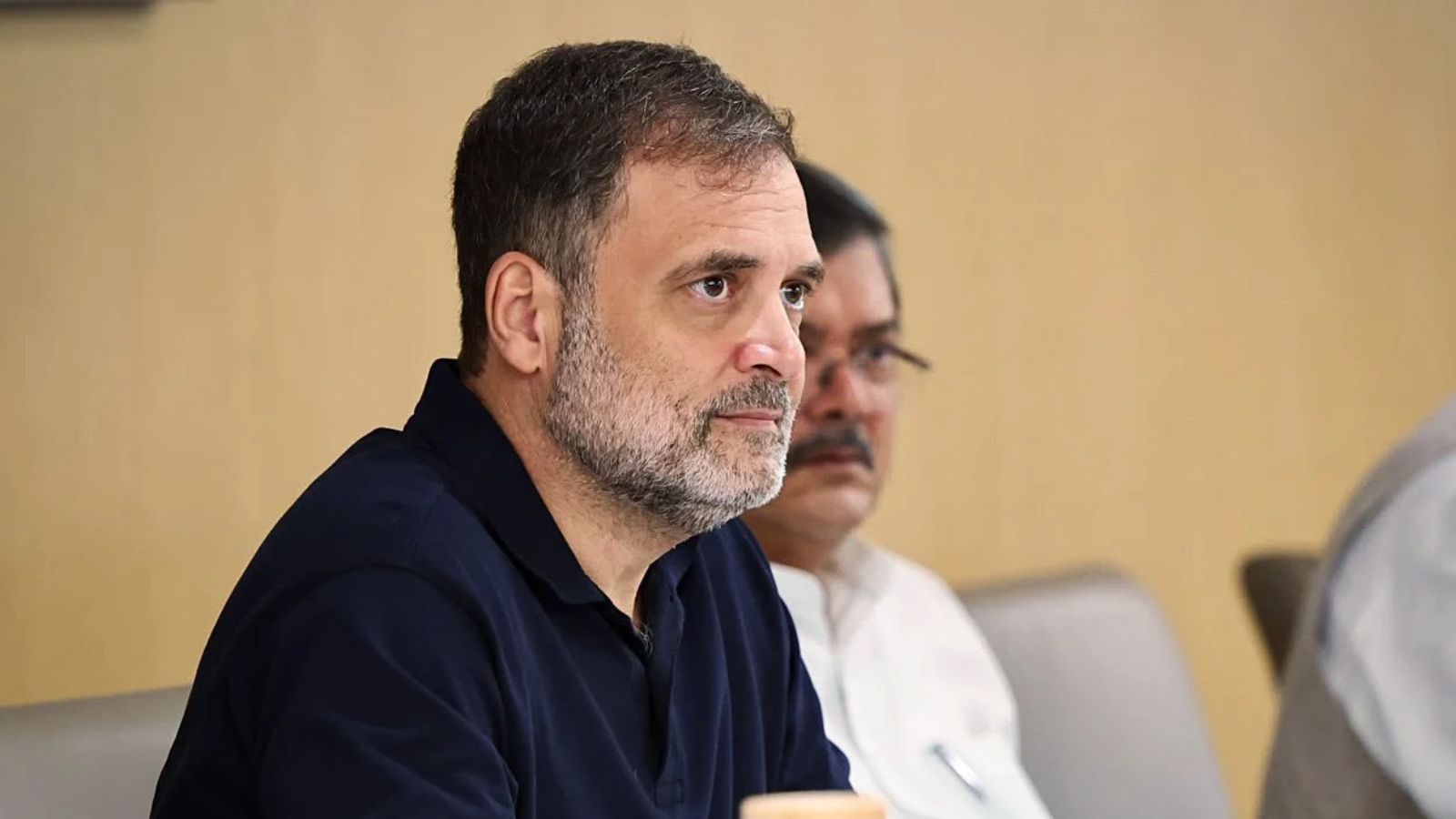


Prayagraj: The Allahabad High Court on Thursday provided relief to Congress leader Rahul Gandhi, refusing to overturn a Varanasi court order rejecting an application for an FIR against him over his alleged remarks on Sikhs during his US visit in 2024.
The court of Chief Judicial Magistrate, Varanasi on October 17, 2025 rejected the application of petitioner Nageshwar Mishra to register a case against Gandhi for his alleged statement.
Newspaper reports quoted Gandhi as saying that Sikhs are not feeling safe in India.
Mishra filed a revision petition before the sessions court which also dismissed it on July 9.
These two orders were challenged before the high court in under section 528 of BNSS.
Justice Vikram D Chauhan dismissed the petition after observing that the sole allegation against Gandhi was of news published in some newspapers about his alleged statement made during his US visits for which no date, time or place have been given.
"In such situation no order to register a case against a person can be passed," the court said.
On October 17, 2025, the Additional Chief Judicial Magistrate, Varanasi, passed an order on Mishra's plea, and on July 9, 2026, the revisional court upheld that order, both declining to direct registration of an FIR against Gandhi.
It was the applicants case that during his US visit in September 2024, Gandhi questioned whether Sikhs in India felt safe wearing turbans or visiting Gurdwaras.
They pointed out that Khalistani terrorist Gurpatwant Singh Pannun had endorsed Gandhi's statement as correct. It was submitted that Gandhi's remarks made the work of terrorists easier and now, the terrorists will take advantage of this statement to try to spread violence and anarchy in India and run a propaganda campaign against India around the world. They further claimed that the remarks could provoke violence in India and aid anti-India propaganda worldwide.
The High Court, however, observed that elected representatives are chosen to carry the voice of people into the institutions of governance.
It added that concerns raised in the legislature or public forums enter the public record, inform citizens and invite scrutiny of government action, thereby keeping democratic discourse alive and vibrant.
The Court further observed that individuals may disagree with Gandhi's statement, but that, by itself, would not be a ground to treat the speech as an offence.
The applicants had argued that the endorsement of Gandhi's remarks by a separatist figure demonstrated that the speech could be used to advance separatist activities.
Rejecting this contention, the Court observed:
"Upon examination, the impugned speech of respondent no. 2 does not tend to incite violence or disturb public order. It merely articulates the concerns of a certain segment of society."
It added that If a third party misinterprets or appropriates the said speech to advance its own ends, the responsibility for any ensuing consequences lies exclusively with that party, which is amenable to the law for its own acts.